


Where are eFoils allowed is a very common question in the eFoil community. We created a country-by-country guide for Europe (inland waters vs seas).
Where are eFoils allowed? In short
Short answer: eFoils are “vessels” in most jurisdictions. You must stay out of bathing zones, respect local speed limits and nature reserves, and—often—register the board if it can exceed a set power or speed.
Details vary by country and by specific lake, river, or coastal stretch. Below you get the most concrete answer on where are eFoils allowed, based on internet research and other sources. Where no reliable rule or authority notice could be found, you’ll see “No restrictions known.”
Disclaimer
This article "Where are eFoils allowed" is for general information only. It is not legal advice, not a permit, and not a substitute for checking the law. Navigation rules change often and vary by country, region, municipality, lake authority, harbourmaster, and protected area. Seasonal bans, temporary notices, emergency measures, and local bylaws can override national rules without wide publicity. Distances, speed limits, equipment mandates, age and licensing, registration, and insurance obligations differ and can change without notice.
Translations and summaries may omit details; the official local language text controls. Examples in this article do not imply that eFoiling is allowed at any specific site. You are solely responsible for verifying current requirements with the competent authority before riding and for operating within marked zones, respecting swimmers, wildlife, nature reserves, and shipping.
Use an eFoil at your own risk. No warranties are given; the publisher and authors accept no liability for fines, bans, losses, injuries, or environmental harm arising from use of this information. For definitive guidance, consult the relevant authority or a qualified maritime professional.
How to read this
- Inland waters = rivers, canals, lakes, reservoirs.
- Seas = coastal waters under the state’s jurisdiction.
- If a rule says “personal watercraft (PWC)” and the authority treats powered boards like small vessels or PWCs, assume the same distance/speed rules unless an explicit exception is stated.
- The EU Recreational Craft Directive harmonizes product compliance, not navigation rules. Local bylaws still govern where you can ride.
The challenge
The electric hydrofoil (eFoil) has rapidly emerged as a revolutionary water sport, offering the silent, low-impact thrill of flight combined with electric motorization. This blend of traditional surfing dynamics with propulsion technology presents a novel challenge to established maritime jurisprudence across Europe.
Since eFoils do not fit neatly into pre-existing categories like sailboards, kayaks, or traditional motorboats, the regulatory landscape is characterized by complexity and variance.
The fundamental issue facing riders and manufacturers alike is the lack of uniform legislation regarding the topic "Where are eFoils allowed". Regulations change significantly from one country to another, often varying even between specific regions or bodies of water within the same country.
Navigating this patchwork of rules requires a detailed understanding of classification, power thresholds, and local environmental sensitivities.
We kindly ask you to share feedback with us, if you have additional information.
Where are eFoils allowed - Table by country
I would like to ask the eFoil community for feedback and your local experience to keep this table updated and to add missing information. Please reach out to us, if you have further information.
This article Where are eFoils allowed" was planned for years, but the regulations are very fragmented and change quickly.
| Country | Inland Waters (Lakes/Rivers) | Coastal/Sea Waters | Registration/License Requirements | Status |
|---|---|---|---|---|
| Albania | No restrictions known | No restrictions known | Always check local authority | No restrictions known |
| Andorra | N/A (Landlocked) | N/A | Check local authority | No restrictions known |
| Austria | Allowed (Regional variance); Banned (Lake Constance) [1] | N/A (Landlocked) | License > 4.4 kW [2] | Highly Regulated Inland |
| Belarus (Non-EU) | No restrictions known | N/A (Landlocked) | Check local authority | No restrictions known |
| Belgium | No restrictions known | No restrictions known | Regulatory Vacuum [3] | No restrictions known |
| Bosnia & Herz. | No restrictions known | No restrictions known (limited coast) | Check local authority | No restrictions known |
| Bulgaria | No restrictions known | No restrictions known | Check local authority [4] | No restrictions known |
| Croatia | Complex, Regional Variance [5] | Complex, Regional Variance [2] | License > 4 hp; Highly localized [2] | Highly Complex/Regional |
| Cyprus | N/A (limited inland use) | No restrictions known | Check local authority [6] | No restrictions known |
| Czech Republic | No restrictions known | N/A (Landlocked) | Check local authority [4] | No restrictions known |
| Denmark | No restrictions known | No restrictions known | Check local authority [4] | No restrictions known |
| Estonia | No restrictions known | No restrictions known | Check local authority [4, 3] | No restrictions known |
| Finland | No restrictions known | No restrictions known | Check local authority [4] | No restrictions known |
| France | Allowed (Local zoning applies) | Generally Allowed (Outside buoy lines) | License > 4.5 kW [2] | Generally Allowed/Zoned |
| Germany | Allowed (Federal Waterways); Banned (Bavarian Lakes/Lake Constance) [7] | Generally Allowed | Registration > 2.21 kW; License > 11.03 kW [8] | Highly Regulated Inland |
| Greece | N/A (limited inland use) | Allowed (Subject to geofencing/zoning) [9] | Leasing requires geofencing [9] | Regulated Coastal Use |
| Hungary | No restrictions known | N/A (Landlocked) | Check local authority [4] | No restrictions known |
| Iceland | No restrictions known | No restrictions known | Check local authority | No restrictions known |
| Ireland | No restrictions known | No restrictions known | Check local harbor master [4, 3] | No restrictions known |
| Italy | Allowed (Riders use foreign registration) [10] | Generally Allowed | No explicit national restriction known | Generally Allowed/Permissive |
| Latvia | No restrictions known | No restrictions known | Check local authority [4, 3] | No restrictions known |
| Liechtenstein | N/A (Landlocked) | N/A | Check local authority | No restrictions known |
| Lithuania | No restrictions known | No restrictions known | Check local authority [4, 3] | No restrictions known |
| Luxembourg | No restrictions known | N/A (Landlocked) | Check local authority [6] | No restrictions known |
| Malta | N/A (limited inland use) | No restrictions known | Check local authority [6] | No restrictions known |
| Moldova | No restrictions known | N/A (Landlocked) | Check local authority [11] | No restrictions known |
| Monaco | N/A (limited inland use) | No restrictions known | Check local authority | No restrictions known |
| Montenegro | No restrictions known | No restrictions known | Check local authority [11] | No restrictions known |
| Netherlands | No restrictions known | No restrictions known | Regulatory Vacuum noted [2] | No restrictions known |
| North Macedonia | No restrictions known | N/A (Landlocked) | Check local authority [11] | No restrictions known |
| Norway | No restrictions known | No restrictions known | Check local authority [4] | No restrictions known |
| Poland | No restrictions known | No restrictions known | Check local authority [4] | No restrictions known |
| Portugal | No restrictions known | No restrictions known | Check local authority [4] | No restrictions known |
| Romania | No restrictions known | No restrictions known | Check local authority [4] | No restrictions known |
| San Marino | N/A (Landlocked) | N/A | Check local authority | No restrictions known |
| Serbia | No restrictions known | N/A (Landlocked) | Check local authority [11] | No restrictions known |
| Slovakia | No restrictions known | N/A (Landlocked) | Check local authority [4] | No restrictions known |
| Slovenia | No restrictions known | No restrictions known (limited coast) | Check local authority [4] | No restrictions known |
| Spain | No restrictions known | Generally Allowed (Outside buoy lines) [1] | No explicit national restriction known | Generally Allowed Coastal |
| Sweden | No restrictions known | No restrictions known | Check local authority [4] | No restrictions known |
| Switzerland | Explicitly Banned [10] | N/A (Landlocked) | N/A (Ban based on length/motorization) [10] | Explicitly Banned |
| Turkey (Non-EU) | No restrictions known | No restrictions known | Check local authority [4] | No restrictions known |
| United Kingdom | No restrictions known (Local bylaws apply) | No restrictions known (Local harbor master applies) | Check local harbor master/MCA guidance [3] | No restrictions known |
| Ukraine (Non-EU) | No restrictions known | No restrictions known | Check local authority [11] | No restrictions known |
| Vatican City | N/A (Landlocked) | N/A | N/A | N/A |
Western and Central Europe
Austria
- Inland waters: Highly fragmented and restrictive. Many lakes prohibit motorized craft entirely or seasonally; several Länder ban electric jet-driven boards as “Schwimmkörper.” Example: Upper Austria states electric surf/wakeboards with jet drive are prohibited under the OÖ Seen-Verkehrsverordnung. Salzburg notes private motorboating is generally not possible on its lakes except limited times on Wolfgangsee. Attersee has a summer motorboat ban (1 July–31 August). Courts have also handled e-foil enforcement cases (Traunsee). Registration required for motorboats; small electrics under 4.4 kW may be exempt from registration, but local lake bans still apply.
- Seas: None.
Belgium
- Inland waters: No country-level e-foil rule located. Expect local police/port bylaws and federal inland navigation rules. No restrictions known.
- Seas: North Sea coast is controlled by local communes and the Flemish agency; bathing zones apply. No restrictions known.
France
- Inland waters: Navigation is governed by Voies Navigables de France and prefectural orders; powered craft are often restricted near bathing areas and on small lakes. Product rules follow Division 240; below 2.5 m you will be treated like beach craft in some cases, but motorized use is tightly restricted near swimmers. Check each département.
- Seas: Standard coastal rules apply. Keep out of 300 m bathing zones, use access corridors, observe local speed limits. Division 240 safety equipment rules apply based on distance from shore.
Germany
- Inland waters: On federal inland waterways e-foils are treated as Kleinfahrzeuge. Registration is mandatory if engine power > 2.21 kW; local speed and traffic rules apply. Several state-managed lakes (e.g., many in Bavaria) do not issue numbers for e-foils and effectively ban them; always check the lake authority.
- Seas: On federal sea waterways, small-craft rules apply; stay clear of bathing areas and protected zones; local coastal ordinances may add limits.
- There is a mored detailed article in German for Germany called "Sind eFoils erlaubt?"
Ireland
- Inland waters: Governed by Waterways Ireland and local bylaws. Follow the national Code of Practice for Recreational Craft for equipment and safe operation; local authorities can restrict PWCs and fast craft in bathing zones.
- Seas: Typical rules: no PWCs or fast craft inside 300 m of the foreshore except via corridors; age and launch restrictions may apply under local orders.
Liechtenstein
- Inland waters: None of significance. No restrictions known.
- Seas: None.
Luxembourg
- Inland waters: Very limited navigable waters; local rules apply. No restrictions known.
- Seas: None.
Monaco
- Inland waters: None.
- Seas: Follows French/Monégasque coastal safety zones and speed limits. No restrictions known.
Netherlands
- Inland waters: If your e-foil can exceed 20 km/h, it is a “snelle motorboot”. You must register with RDW, have a Y-number, meet age and often license requirements, and use only permitted fast-sailing zones. Below 20 km/h you are a regular small craft but still bound by local limits and nature reserves.
- Seas: Coastal operations follow general vessel rules; observe bathing-zone and speed restrictions posted by municipalities and the Kustwacht. No single national e-foil exception.
Switzerland
- Inland waters: Regulated by canton. Several lakes and cantonal authorities ban e-foils or treat them as motorboats but decline registration. Zurich has publicly stated that e-surf/e-foil operations are not permitted on its lakes for safety reasons. Expect strict controls on most large lakes.
- Seas: None.
United Kingdom
- Inland waters: Managed by navigation authorities and local bylaws.
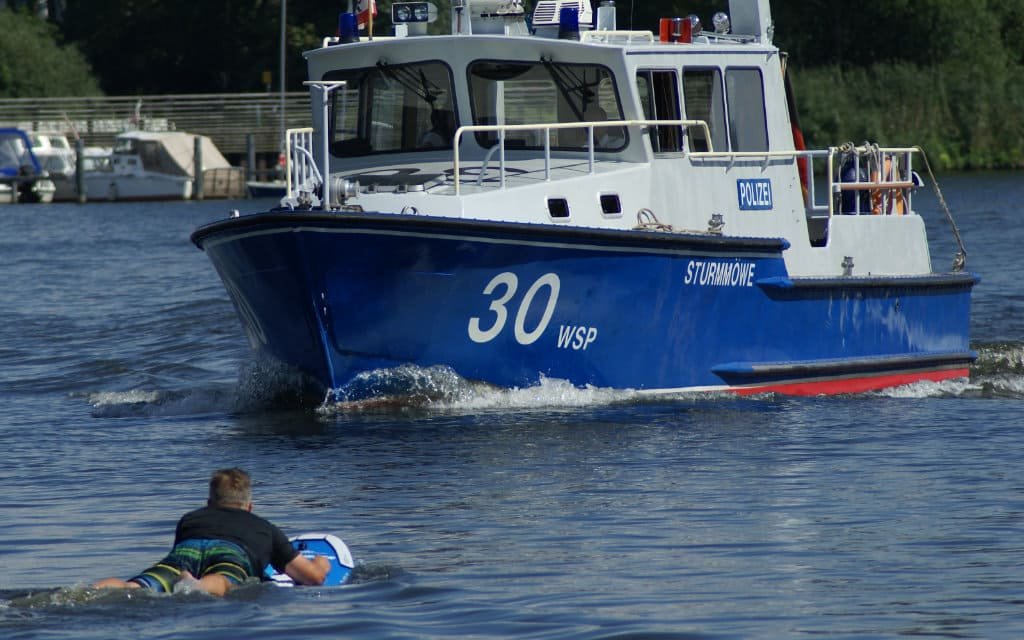
- Seas: Since 2023 the Merchant Shipping (Watercraft) Order 2023 applies to mechanically propelled recreational watercraft, extending safety and conduct rules to craft such as e-foils. Harbours often impose no-go bathing zones and speed limits; check local harbourmaster notices.
Nordics and Baltics
Denmark
- Inland waters: Local authorities regulate lakes; many are sensitive nature areas. No restrictions known beyond general navigation rules.
- Seas: General rule near coasts: no powered navigation within 300 m of the shore except perpendicular transit at ≤ 5 kn via corridors. Nature reserves and wildlife sanctuaries are off-limits. Police districts publish additional 300 m rules and fines.
Finland
- Inland waters: Governed by the Water Traffic Act; Traficom can impose regional prohibitions for specific watercraft types if they cause significant harm. Always check local restrictions and nature areas.
- Seas: Gulf of Finland and archipelago areas have special navigational cautions; general small-craft rules apply. No restrictions known specific to e-foils.
Iceland
- Inland waters: Local harbour and environment rules; limited access. No restrictions known.
- Seas: Coastal harbours set speed and bathing-zone rules. No restrictions known.
Norway
- Inland waters: Municipal rules and protected-area regulations apply; small-craft rules and right-of-way laws (Sjøveisreglene) govern behavior. No restrictions known specific to e-foils.
- Seas: Observe 5-kn limits near swimmers/harbours where posted; many fjords have local rules. No restrictions known.
Sweden
- Inland waters: After legal challenges to the historic PWC ordinance, enforcement uses general boating and environment rules; PWC license now required, but e-foils are generally treated as small craft unless classified otherwise locally. Avoid bathing zones; follow speed limits.
- Seas: Standard coastal restrictions and local bathing-zone distances. No restrictions known specific to e-foils.
Estonia / Latvia / Lithuania
- Inland waters and seas: National small-craft laws and local bathing-zone bylaws apply; no e-foil-specific national rules located. No restrictions known.
Southern Europe
Croatia
- Inland waters: Limited for motorized recreation; check county notices. No restrictions known beyond general bans where posted.
- Seas: New 2025 safety rules set minimum distances to shore and treat jet skis and planing craft with stricter limits. Broadly: within 150 m max 5 kn, 150–300 m max 8 kn; jet skis/planing boats from ≥ 300 m offshore; organised bathing areas are off-limits. Several official and industry summaries confirm the 2025 changes.
Cyprus
- Inland waters: Minimal. No restrictions known.
- Seas: Coastal zones and bathing corridors enforced by Port/Marine Police; treat as PWC/small craft. No restrictions known.
Greece
- Inland waters: Scarce. No restrictions known.
- Seas: Specific e-foil regulation published via Safe Water Sports: no use among bathers; stay ≥ 200 m from swimming range or buoys and ≥ 300 m from the coastline where there are no bathers; only daylight; helmet + impact vest mandatory; no simultaneous operation with PWCs; launch/land via lanes; geofencing allowed for rentals.
Italy
- Inland waters: Rules are local. Many lakes set 150–300 m bathing buffers and speed caps; parts of Lake Gardaprohibit motorboats in the Trentino sector and enforce ≤ 5 kn within 150 m with 20 kn daytime offshore caps elsewhere. Expect harbour-master ordinances to govern.
- Seas: Capitaneria di Porto issues bathing-season ordinances. Standard pattern: keep 200–300 m off bathing areas, transit perpendicular at ≤ 5 kn, daylight use for PWCs. Check the local “Ordinanza di Sicurezza Balneare.”
Malta
- Inland waters: None.
- Seas: Transport Malta posts seasonal bathing zones and PWC rules. No restrictions known specific to e-foils.
Portugal
- Inland waters: Local river and dam rules apply. No restrictions known.
- Seas: Recreational craft regulation sets 300 m bathing zones and daylight limitations for motorized boards and PWCs close to shore; use corridors, otherwise stay outside the restricted belt. Registration and identification rules apply to ER Type D nearshore craft.
Spain
- Inland waters: River authority and regional rules apply; no navigation in signed bathing zones. No restrictions known beyond that.
- Seas: National beach zoning: 200 m bathing belt on beaches (50 m elsewhere). Motor craft must remain outside, except via marked channels at low speed. PWCs have specific decrees; powered boards follow the same exclusion principles near swimmers.
Alpine, Balkans, and Eastern Europe
Bosnia and Herzegovina
- Inland waters: Local rules at reservoirs/rivers. No restrictions known.
- Seas: 20 km coastline at Neum; local harbour rules apply. No restrictions known.
Bulgaria
- Inland waters: River Danube sections follow international rules; lakes are locally regulated. No restrictions known.
- Seas: Black Sea coastal municipalities set bathing zones. No restrictions known.
Croatia
- Inland waters: Local rules at reservoirs/rivers. No restrictions known.
- Seas: Coast has bathing belts and speed limits via Harbour Master ordinances No restrictions known.
Montenegro
- Inland waters: Limited. No restrictions known.
- Seas: Boka and coast have bathing belts and speed limits via Harbour Master ordinances. No restrictions known.
North Macedonia
- Inland waters: Lakes have protected zones. No restrictions known.
- Seas: None.
Serbia
- Inland waters: River authorities regulate; local bans in bathing areas. No restrictions known.
- Seas: None.
Slovenia
- Inland waters: Many lakes prohibit motorized craft; check municipal bylaws. No restrictions known.
- Seas: Short Adriatic coast with bathing zones and marked corridors. No restrictions known.
Albania
- Inland waters: Lake rules vary. No restrictions known.
- Seas: Coastal municipalities post bathing belts and PWC limits. No restrictions known.
Romania
- Inland waters: Danube and lakes under national and local rules. No restrictions known.
- Seas: Black Sea bathing zones enforced by lifeguard services and harbourmasters. No restrictions known.
Moldova
- Inland waters: Rivers and reservoirs; local rules. No restrictions known.
- Seas: None.
Ukraine
- Inland waters: Local restrictions vary and are volatile due to wartime conditions. No restrictions known.
- Seas: Access restricted in conflict zones. No restrictions known.
Belarus
- Inland waters: Local rules. No restrictions known.
- Seas: None.
Russia
- Inland waters: Regional rules. No restrictions known.
- Seas: Coastal jurisdictions and bathing areas. No restrictions known.
Czechia
- Inland waters: National small-craft rules apply, with licensing thresholds and equipment requirements; many lakes restrict motorized craft, and protected waters often ban combustion engines. Expect registration or operator requirements depending on power and speed; local bans common.
- Seas: None.
Hungary
- Inland waters: Balaton and other lakes have strict speed/bathing belts and nature zones; motorized surfing often restricted. No restrictions known at national level for e-foils.
- Seas: None.
Poland
- Inland waters: Rules vary by voivodeship and lake; many areas impose ≥ 100 m buffers from bathing zones for motor craft and seasonal PWC bans on specific lakes. Check county and Inland Navigation Office orders.
- Seas: Maritime offices mark bathing areas; stay clear with motorized craft. No restrictions known specific to e-foils.
Slovakia
- Inland waters: River/Danube rules plus municipal bans on reservoirs. No restrictions known.
- Seas: None.
Bosporus and Black Sea edge
Turkey
- Inland waters: Limited recreational zones; local governance. No restrictions known.
- Seas: Harbourmaster orders govern bathing belts and speed. No restrictions known.
Key patterns you must respect everywhere
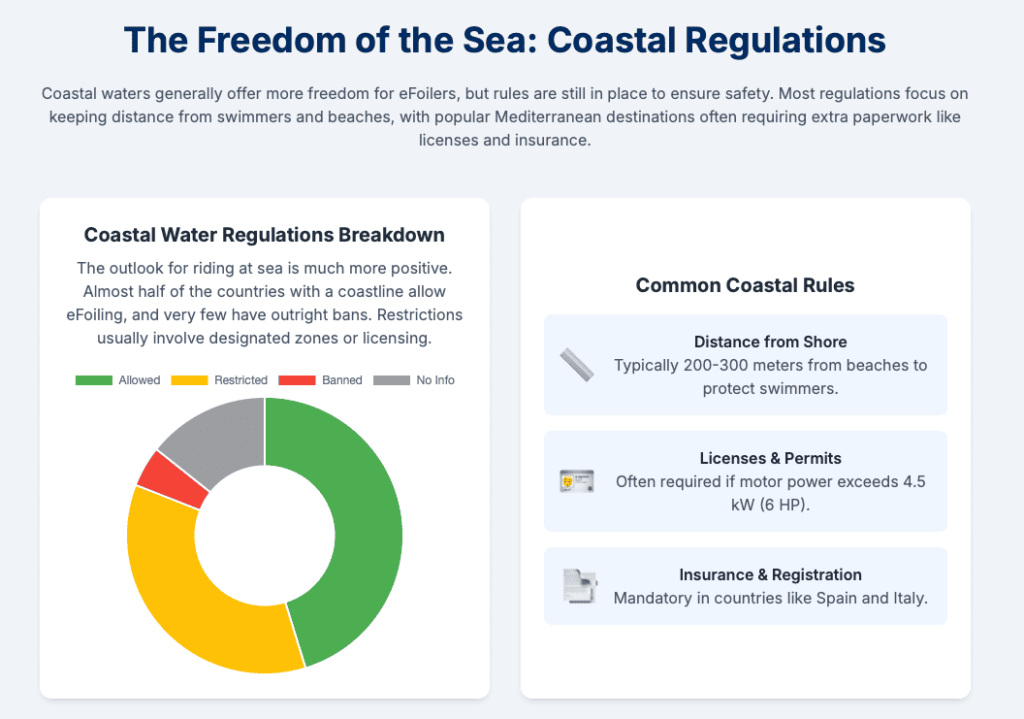
- Bathing belts: Expect 200–300 m exclusion from beaches. If channels exist, use them perpendicular to shore at ≤ 5 kn. Examples: Spain 200 m/50 m; Denmark 300 m; Italy lake/harbour ordinances; Greece explicit e-foil distances; Croatia 2025 regime.
- Registration/identification: Germany > 2.21 kW must register on federal inland waters. Netherlands: > 20 km/h = snelle motorboot, RDW registration and Y-number. Austria often requires registration for motorboats but local lake bans override.
- Licensing/age: Netherlands often requires a vaarbewijs and minimum age for fast craft; Sweden requires a PWC certificate; local age rules for rentals in Greece.
- Protected areas: Nature reserves, bird sanctuaries, and drinking-water lakes frequently prohibit motorized boards entirely (e.g., Swiss lakes, parts of Austria and Germany/Bavaria).
- Harbour bylaws rule the details: Where national law is silent, harbourmasters and municipalities set the binding lines, buoys, and speeds.
Where are eFoils allowed - summary
So… where are eFoils allowed?
They are allowed almost everywhere offshore beyond bathing belts and rarely allowed in crowded small lakes. The exact line is set locally. The safest default is: outside the bathing zone, inside marked corridors at idle, with registration/licensing if your board qualifies as a fast or powered craft. See country notes and linked authority pages above.
Examples of explicit, recent rules
- Greece (sea): Helmet + impact vest, daylight only, ≥ 200–300 m from swimmers/shore, rental geofencing allowed, no co-use with PWCs.
- Croatia (sea, 2025): ≥ 300 m for planing craft and PWCs; ≤ 5–8 kn near shore; bathing zones off-limits.
- Netherlands (inland): RDW registration and Y-number for e-foils exceeding 20 km/h; fast-sailing zones only.
- Germany (inland): Registration if > 2.21 kW on federal waterways; many state lakes refuse e-foil numbers.
- Denmark (sea): 300 m coastal rule and ≤ 5 kn perpendicular transit.
Compliance checklist before you ride
- Confirm if your e-foil meets the trigger for registration or licensing where you ride (power in DE/AT, speed in NL, certificate in SE, local authorizations elsewhere).
- Check the bathing-zone distance and local speed limits. Spain 200 m, Denmark 300 m, Italy/Greece/Croatia similar patterns. Use only marked corridors to launch/land at ≤ 5 kn.
- Verify protected areas and wildlife refuges. Many lakes ban motorized boards outright (e.g., parts of Switzerland, Austria).
- Carry mandatory safety gear if required locally; rentals in Greece require helmet + impact vest; many countries strongly recommend PFDs.


 23 min read



