JETSURF is a Czech manufacturer of motorised surfboards. The jetboards are built in-house from carbon fibre and come as fully electric models and with a two-stroke petrol engine. At E-SURFER you get seven models between 13.078 and 16.648 € — every one of them ridden and tested by us.
We specialise in electric watercraft, so the electric models come first. The five petrol boards follow, sorted by price. All prices include VAT.
Why buy from E-SURFER?
Eight brands, dozens of models ridden by us. We tell you honestly which board suits you.
We recommend electric in most cases, and not only out of conviction: electric watercraft have been our field since 2017, which is where we have the most hours on the water and the most customer feedback. A JETSURF Electric has no part that needs regular attention — no carburettor, no spark plug, no exhaust. It is also quiet and produces no local emissions. The 3 kWh battery lasts 25 to 55 minutes and charges in three hours. On many inland waters the quiet drive is the practical advantage, not the ecological one.
The petrol boards still have their place. They weigh between 18,5 and 24,9 kg, which makes them the lightest motorised surfboards there are, refuelling takes a minute, and with an empty tank a petrol board can even travel by plane — a 3 kWh battery is far above the limit for lithium batteries in air transport. If you ride long distances or fly with your board, petrol is the better fit.
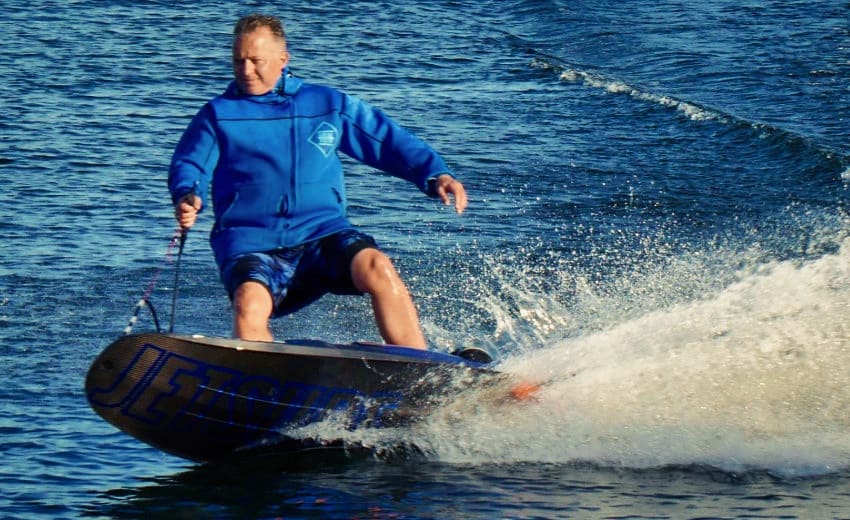
Petrol still dominates racing. JETSURF has been running its own events since 2012, and since 2015 as the MotoSurf WorldCup under the world governing body UIM. There is now an electric class as well. The engines are that durable for a reason: behind them stands MSR Engines, which has been developing racing engines since 1994, among others for KTM, the Red Bull Rookies Cup and Formula BMW.
The suffixes confuse people regularly. SL means the board without a handlebar, controlled by a hand throttle on a leash. SKI means the stand-up ski with a fixed handlebar in front of the rider. The Electric 2 and the Adventure DFI Plus are boards too, they simply do not carry the suffix.
What it means in practice: the handlebar gives you a second point of contact and allows a far more aggressive riding style, but it makes the start harder, because you have to pull it past you as you stand up. And it is removable — a SKI turns into a board, never the other way round. If you are not sure yet, the stand-up ski is the more flexible buy.
We filmed this video of the Ski for our YouTube channel:
You are currently viewing a placeholder content from YouTube. To access the actual content, click the button below. Please note that doing so will share data with third-party providers.
How jetboards differ from eFoils in general is covered in our jetboard comparison and in the article jetboard or eFoil.
We at E-SURFER have been riding electric surfboards since 2017 and have carried JETSURF from the start. Every model we sell we have ridden ourselves — not at a trade show, but on the water. Our full test of the electric model is in the JETSURF Electric review.
We also have a direct line into the factory. We talk to the people who build these boards, which is why we know early what changes from one model year to the next — and why we were able to publish an interview with JETSURF founder Martin Šula.
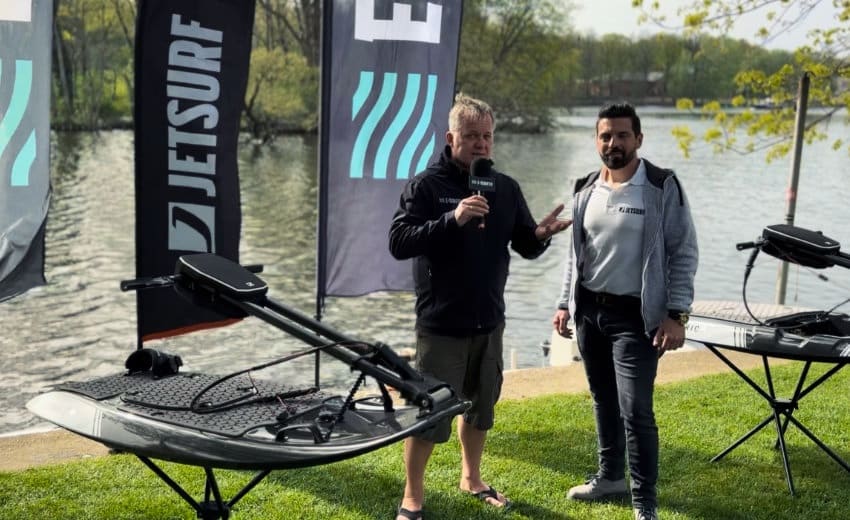
What stands out after all these years: the difference between petrol and electric is smaller than most people expect — the difference between board and stand-up ski is far bigger. Riders coming from a board need the first fifteen minutes to get the start right on a ski. After that, many do not want to go back.
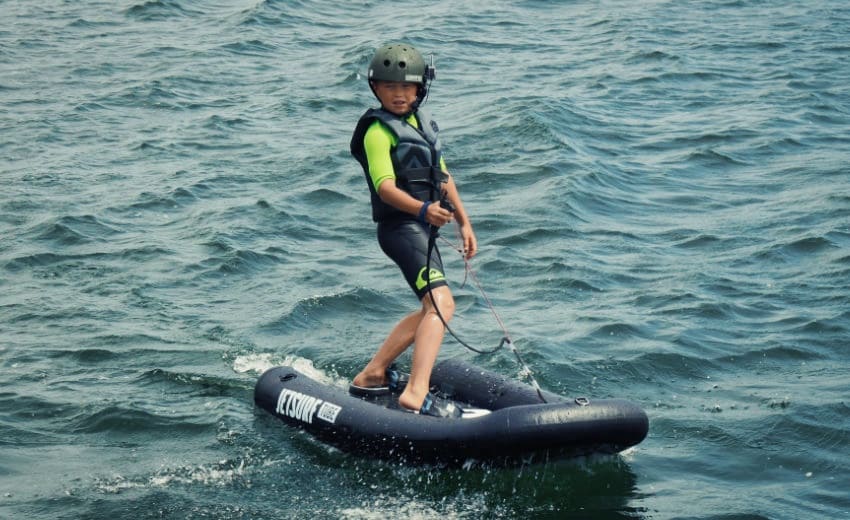
For the first attempts the manufacturer offers the JETSURF Tube. It is inflated and attached to the board, increases buoyancy and makes standing up much easier. It is the quickest way to get younger or lighter riders onto a board. We do not stock the Tube — if you need one, we will tell you where to get it.
In the UK there is no national licence, registration or number plate for a motorised surfboard. What decides where you can ride is local: council and harbour byelaws at the coast, and inland the waterway operators — the Canal & River Trust and the Environment Agency require a licence or registration for powered craft. A JETSURF sits closest to the personal watercraft category, so speed limits, designated zones and exclusion areas usually apply. Scotland has its own rules.
The full picture is in our guide eFoils in the UK: rules, licences and where to ride, and for the rest of Europe and North America in our overview of eSurfboard regulations. Note that JETSURF does not publish the power output of its engines — which is exactly the figure that decides the rules in countries like Germany. For your own water, call us and we will work it out with you.
If you are torn between two models, call us on +49 30 2060 9981 or write to us via the contact page. The first thing we ask is where you want to ride and how much you weigh — that decides more than any spec sheet. And if you have a better offer somewhere else, send it over: as a rule we will beat it.
The seven JETSURF models we carry cost between 13.078 and 16.648 € including VAT. The most affordable is the Race DFI SL at 13.078 €, the most expensive are the Titanium DFI SKI and the Electric-jet Ski at 16.648 € each. The two electric models sit at 14.869 and 16.648 €.
Yes, but with stricter rules than an eFoil. In the UK there is no national licence, registration or number plate for a motorised surfboard. What decides where you can ride is local: council and harbour byelaws at the coast, and inland the Canal & River Trust or the Environment Agency, which require a licence or registration for powered craft. A JETSURF is jet-driven and ridden on the hull, so it sits closer to the personal watercraft rules than an eFoil does. Details in eFoils in the UK: rules, licences and where to ride.
JETSURF models reach between 55 and 62 km/h. The fastest are the Titanium DFI SL and the Titanium DFI SKI at 62 km/h, followed by the Race DFI SL and the Race DFI SKI at 58 km/h. The two electric models and the Adventure DFI Plus top out at 55 km/h. Standing on 1,80 metres of board, those numbers feel far faster than the same speed in a car.
The petrol models weigh between 18,5 and 24,9 kg, the electric ones 32,9 kg as a board and 38,3 kg as a stand-up ski. The lightest are the Titanium DFI SL and the Adventure DFI Plus at 18,5 kg, followed by the Race DFI SL at 19,5 kg. Both petrol stand-up skis come in at 24,9 kg. The gap to the electric models comes almost entirely from the battery, which weighs 18 kg on its own.
JETSURF states a maximum load of 120 kg for the petrol models and 100 kg for the two electric ones. That figure covers the total weight on the board, so rider plus gear. If you are close to the limit, a petrol model is the safe choice: it carries 20 kg more and weighs considerably less itself.
In the UK, no national licence exists for a motorised surfboard, so nothing is required from central government. What can be required is local: inland waterway operators such as the Canal & River Trust and the Environment Agency licence or register powered craft, and some harbours and clubs ask for an RYA qualification or insurance. Elsewhere it depends on engine power, and JETSURF does not publish that figure. See eFoils in the UK or call us for your water.
In most cases we recommend electric: no carburettor, no spark plug, no exhaust, plus quiet and free of local emissions. The 3 kWh battery lasts 25 to 55 minutes and charges in three hours. Petrol keeps the advantage in weight, 18,5 to 24,9 kg, and in a one-minute refuel, which matters mainly on long sessions. On many inland waters the quiet drive is the practical advantage anyway, not the ecological argument.
We recommend the two electric models, because that is where we have the most experience since 2017. The JETSURF Electric 2 costs 14.869 €, weighs 32,9 kg and does up to 55 km/h — the choice if you want to ride quietly and with little maintenance. If you want a fixed handlebar, take the Electric-jet Ski at 16.648 €. We also carry the five petrol models; which one fits is best sorted out on the phone.
SL means the board without a handlebar, controlled by a hand throttle on a leash. SKI means the stand-up ski with a fixed handlebar in front of the rider. The Electric 2 and the Adventure DFI Plus are boards as well, they simply do not carry the suffix. The handlebar is removable, so a SKI turns into a board — never the other way round.
JETSURF states 25 to 55 minutes per charge, for the Electric 2 as well as the Electric-jet Ski. The range is realistic: ride flat out and you are at the lower end, cruise and you are at the upper end. The 3 kWh battery recharges in three hours and can be swapped — a second battery doubles your time on the water.




PayPal uses Google reCAPTCHA to help secure the payment process. (More Information)
You need to load content from reCAPTCHA to submit the form. Please note that doing so will share data with third-party providers.
More InformationYou are currently viewing a placeholder content from Turnstile. To access the actual content, click the button below. Please note that doing so will share data with third-party providers.
More InformationYou are currently viewing a placeholder content from Facebook. To access the actual content, click the button below. Please note that doing so will share data with third-party providers.
More InformationYou are currently viewing a placeholder content from Instagram. To access the actual content, click the button below. Please note that doing so will share data with third-party providers.
More InformationYou are currently viewing a placeholder content from X. To access the actual content, click the button below. Please note that doing so will share data with third-party providers.
More Information


