An electric jet ski is a personal watercraft with an electric motor and a jet pump — no petrol, no exhaust, no engine noise. At E-SURFER we stock the models you can actually buy, not the ones announced at boat shows. We ride them ourselves, and have done since 2017.
Fewer than the headlines suggest. The major jet ski brands have yet to bring an electric production model to market in any volume. What is genuinely available comes from smaller manufacturers — and those craft differ from one another more fundamentally than a shared search term implies.
| Model | Type | Weight | Top speed | Run time | Price |
|---|---|---|---|---|---|
| JETSURF Electric 2 Ski | Stand-up jet ski | 38.3 kg | 55 km/h | 25–55 min | 16,648 € |
| Awake NAVI | Seated foiler | not published | 30 km/h | up to 3 hrs | 48,088 € |
Every figure comes from the manufacturer. Where a manufacturer publishes nothing, nothing appears here — Awake still gives no weight, no motor power and no dimensions for the NAVI.
A seated electric jet ski in the classic sense is still missing here. It does exist: the Swedish manufacturer Roxen Innovations begins deliveries for the 2027 season, and we rode the craft ourselves on the river Spree in July 2026. As soon as it can be ordered from us, it will appear in this place.
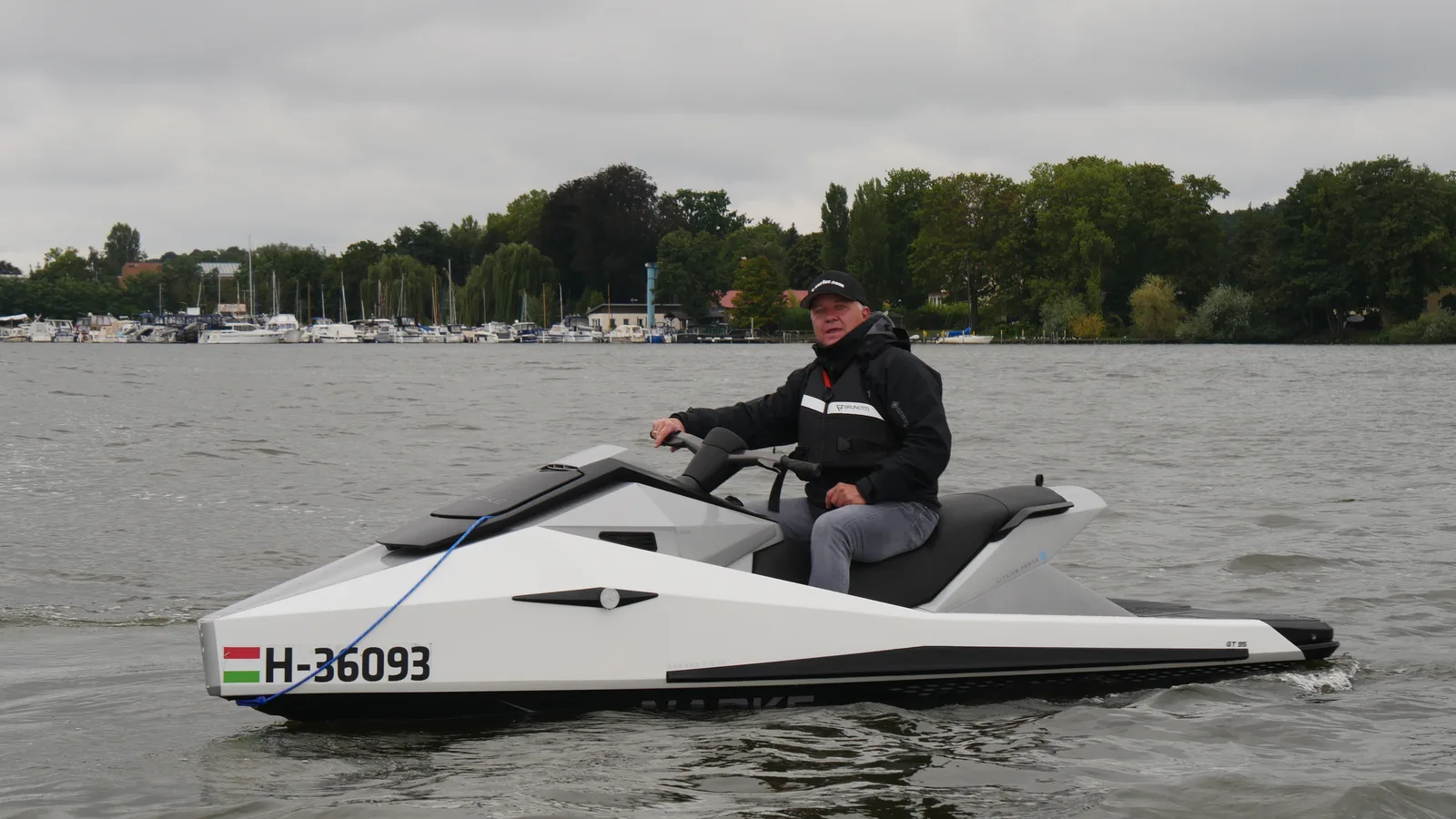
We have not just started paying attention. Back in 2021 we test-rode a prototype of the Narke Electrojet GT95 — carbon hull, 95 hp, 24 kWh battery, three seats. The Hungarian manufacturer was among the very first, and on paper it read superbly. It never reached the market all the same: announced yes, sold almost not at all.
That is the pattern of this category. It gets announced, it gets shown at boat shows, and then nothing happens. Anyone buying an electric jet ski today should look less at the spec sheet and more at who stands behind it — and whether deliveries actually happen.
A year later, in Cannes in 2022, we rode the Overboat — a hydrofoil jet ski by the French manufacturer Neocean that flies above the water instead of planing on it. That chapter has closed too: Neocean ceased operations in March 2024, and its patents and assets were sold.
You are currently viewing a placeholder content from YouTube. To access the actual content, click the button below. Please note that doing so will share data with third-party providers.
We have been writing about all of this regularly on the E-SURFER blog for years: which electric jet skis get announced, which actually reach the market, and which disappear again. This category is the result — only craft that genuinely exist appear here.
The Awake NAVI is an electric foiler: it rides on a hydrofoil and lifts its hull clear of the water. That is a different thing from a jet ski, which planes on the surface. We say so just as plainly on its own product page.
It belongs in this category because it answers the same question an electric jet ski does: how to travel seated, electrically and quietly across water. Anyone shopping for an electric jet ski should know it exists and then decide for themselves between foil and hull. A foiler is markedly quieter and more efficient; a jet ski is more forgiving of rider error.
Between 16,648 and 48,088 euros including VAT. The entry point is the stand-up JETSURF Electric 2 Ski at 16,648 euros, and the Awake NAVI as a seated foiler costs 48,088 euros.
That places electric jet skis alongside well equipped petrol machines. The difference shows in running costs: an hour on the water costs around one euro in electricity. A petrol craft burns 20 to 40 litres in the same time. On top of that, whole categories of maintenance disappear — there are no spark plugs, no carburettor and no exhaust.
It depends entirely on where you ride. In the UK there is no craft-specific national licence for personal watercraft, so what governs you is local: coastal byelaws and harbour authorities regulate personal watercraft closely, and inland waters such as the Canal & River Trust or the River Thames require their own licence, registration and usually insurance. Our guide to the UK rules sets out the detail.
Across much of the EU a power threshold applies instead, and it is usually tied to continuous rated power rather than the peak figure manufacturers advertise. In Germany craft up to 7.5 kW continuous need no licence; in Italy, Spain and Poland a licence is required for any personal watercraft regardless of output. Many manufacturers do not publish a continuous rating at all, which makes the question impossible to answer from a spec sheet. Call us and we will check it for your water.
The pull. An electric motor delivers full torque from the first revolution. That is why an electric craft feels more direct at lower speeds than its power figure suggests next to a 300 hp petrol machine. At the top end the relationship reverses.
The weight. A conventional jet ski weighs 300 to 400 kg and requires a trailer, a tow car and a slipway. The JETSURF Electric 2 Ski weighs 38.3 kg and fits in any estate car. For many riders that, and not the emissions figure, is the actual reason to switch.
Run time. Here petrol wins outright. Twenty-five to seventy-five minutes per charge against a two-minute refuelling stop. Swappable batteries soften that; they do not solve it.
Noise. On many inland waters this is the practical advantage: where a petrol jet ski causes conflict, an electric craft goes largely unnoticed.
You want to stand up and ride hard: the JETSURF Electric 2 Ski. At 38.3 kg the lightest craft here, and its fixed handlebar allows a more aggressive style. Take the bar off and you are riding a jetboard.
You want to sit down, maximum quiet and long sessions: the Awake NAVI. Up to three hours on the foil, with room for two. In exchange, the highest price here and a different riding technique.
If you are unsure, call us on +49 30 2060 9981 or visit our showroom at Funkhaus Berlin.
An electric jet ski is a personal watercraft driven by an electric motor and a jet pump, running without petrol, exhaust or engine noise. It comes as a stand-up craft and in the seated form of a classic jet ski. Unlike a combustion engine it delivers full torque immediately, though run time is limited to 25 to 75 minutes per charge.
An electric jet ski costs between 16,648 and 48,088 euros including VAT. The JETSURF Electric 2 Ski sits at 16,648 euros and the Awake NAVI at 48,088 euros. Running costs differ sharply from petrol: around one euro of electricity per hour against 20 to 40 litres of fuel.
It depends where you ride. The UK has no craft-specific national licence for personal watercraft, so coastal byelaws, harbour authorities and inland navigation bodies set the rules, and inland waters usually require their own licence and insurance. Much of the EU applies a power threshold instead, based on continuous rated power rather than advertised peak output.
Between 25 and 75 minutes depending on the model, and up to three hours for the Awake NAVI as a foiler. The spread is genuine and depends almost entirely on how hard you ride: flat out puts you at the bottom of the range. Swappable batteries extend a session without waiting for a charge.
Yes, and it is one of the biggest advantages over a petrol jet ski. The ROXEN weighs 79 kg without its battery and travels on an ordinary car roof rack; the JETSURF Electric 2 Ski at 38.3 kg fits in any estate car with the rear seats down. Tow hitch, slipway and mooring all become unnecessary.
No. The Awake NAVI is an electric foiler: it rides on a hydrofoil and lifts its hull clear of the water, whereas a jet ski planes on the surface. It appears in this category because it answers the same question — riding seated, electrically and quietly — and therefore belongs in any comparison.




PayPal uses Google reCAPTCHA to help secure the payment process. (More Information)
You need to load content from reCAPTCHA to submit the form. Please note that doing so will share data with third-party providers.
More InformationYou are currently viewing a placeholder content from Turnstile. To access the actual content, click the button below. Please note that doing so will share data with third-party providers.
More InformationYou are currently viewing a placeholder content from Facebook. To access the actual content, click the button below. Please note that doing so will share data with third-party providers.
More InformationYou are currently viewing a placeholder content from Instagram. To access the actual content, click the button below. Please note that doing so will share data with third-party providers.
More InformationYou are currently viewing a placeholder content from X. To access the actual content, click the button below. Please note that doing so will share data with third-party providers.
More Information


 GO TO PRODUCTS


