Roxen Innovations is a Swedish company that builds the ROXEN — an electric jet ski weighing 79 kilograms that does away with the trailer entirely. The approach behind it is unusual: Roxen did not electrify a petrol jet ski, but designed a new craft from scratch with weight as the governing target.
Roxen Innovations AB is based in Linköping and Stockholm. The company concentrates on a single product and its accessories — the ROXEN, plus a swappable battery, a charger and a control tablet. That is a deliberate decision against a broad model range and in favour of one craft developed properly.
Deliveries of the ROXEN begin for the 2027 season. Until then, orders run as reservations.
A conventional jet ski weighs three to four hundred kilograms, and everything else follows from that: a trailer, a tow car with a hitch, a slipway, winter storage. The ROXEN weighs 79 kilograms without its battery, and the battery a further 33. That is 112 kilograms split across two parts that can be carried separately.
In practice, two people carry the craft to the water, the battery follows on its own, and transport happens on an ordinary car roof rack. At 2.6 metres the ROXEN is shorter than many longboards.
Power output is 22 kW, or 30 hp. Top speed is 30 knots, around 56 km/h. The 5.25 kWh battery is good for up to 75 minutes and recharges from a domestic socket in two and a half to three hours.
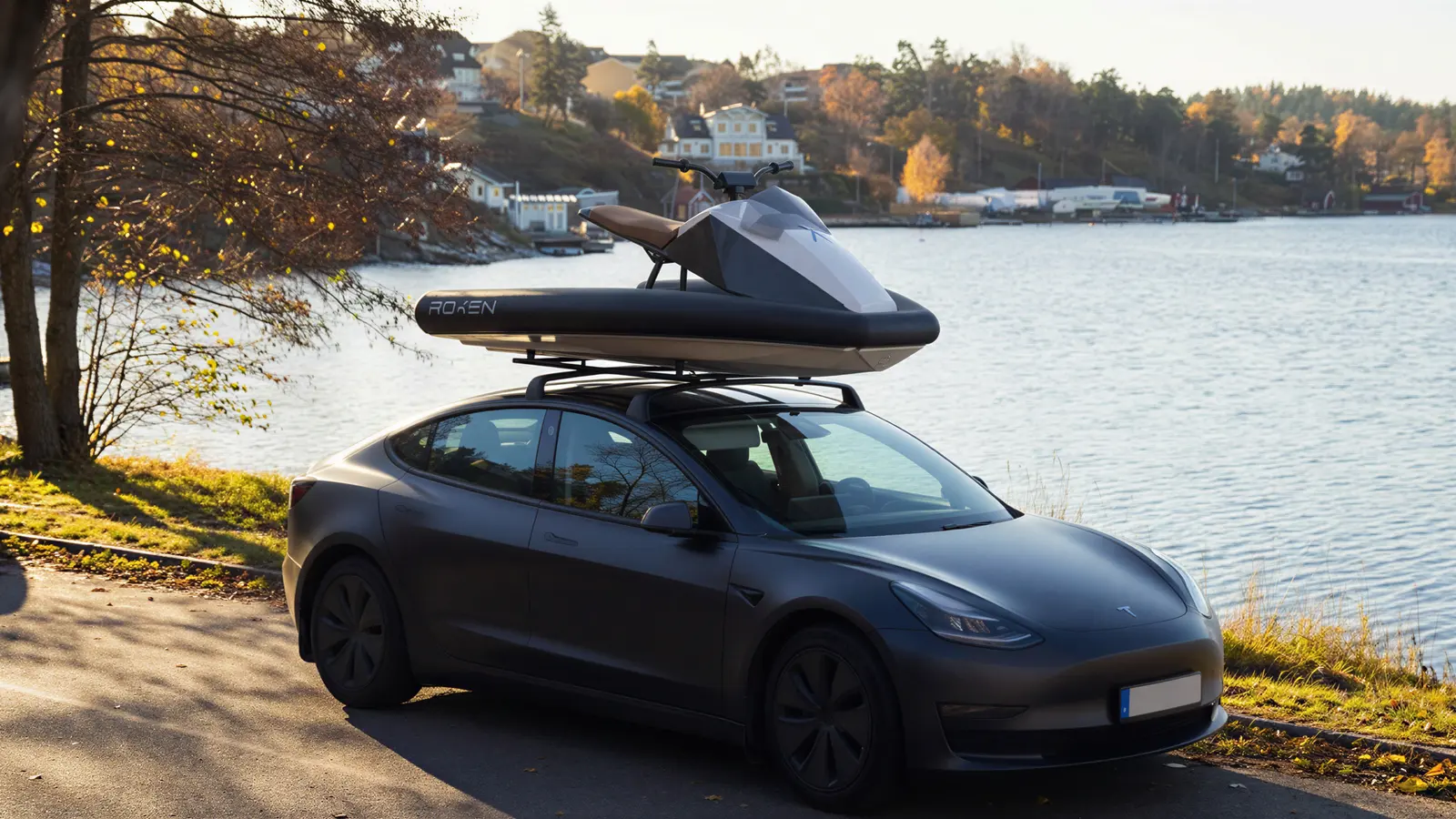
Roxen treats weight not as a by-product but as the figure everything else hangs on. A lighter craft needs less energy for the same speed, therefore gets by with a smaller battery — and becomes lighter again as a result.
Three decisions carry that. The hull is ABS plastic rather than fibreglass or composite. The battery sits low and contributes to the structure instead of merely being carried. And it reaches 159 watt-hours per kilogram — by Roxen's own reckoning the lightest battery per kilowatt-hour in the marine leisure market.
The drivetrain is an electric jet drive without a gearbox. What is not fitted cannot fail: no ignition, no carburettor, no exhaust. That is the real maintenance argument, rather than the emissions figure.
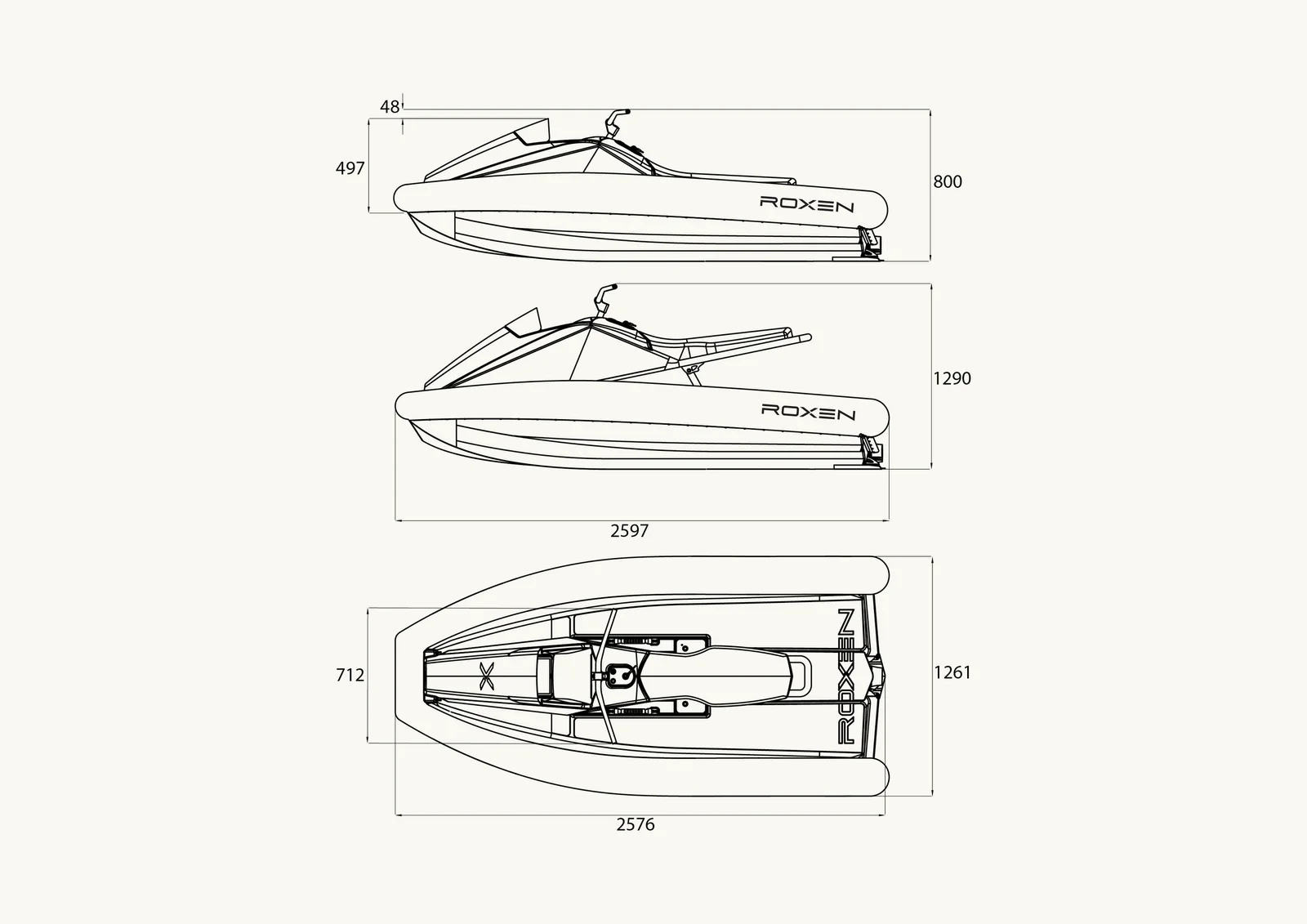
On 16 July 2026 we took the ROXEN onto the river Spree, directly outside our showroom and test centre at Funkhaus Berlin. Three things stayed with us.
How it turns. The ROXEN comes round tighter than you would credit a craft this long — the low weight tells in every corner.
The pull. Nought to forty is remarkably direct. An electric motor gives its torque from the first revolution; a combustion engine has to build it. Above that you notice there are no 300 horses at work — below it, you do not.
The quiet. You hear water and wind. Nothing else.
We also towed a foiler behind the ROXEN that day: Isak Hemmingsson, Chief Commercial Officer of Roxen Innovations, who had come to Berlin specially for it. It worked — though Roxen publishes no permitted towing load, so that is an observation rather than a promise.
You are currently viewing a placeholder content from YouTube. To access the actual content, click the button below. Please note that doing so will share data with third-party providers.
We write only what is documented. On four points the manufacturer gives no figure: the permitted number of riders, the maximum load, the continuous rated power and any CE or recreational craft certification. Every image shows a single rider.
The continuous rating in particular is no small matter — across much of the EU it decides whether a licence is required. At 22 kW peak, one should be assumed. As soon as Roxen publishes reliable figures, they will appear here.
We have followed the electric jet ski market since 2017 and run the world's first blog and YouTube channel devoted to electric watercraft. Production electric jet skis remain rare — the ROXEN is one of the few that made it past prototype status.
For the 2027 season we will have a demo craft in our showroom at Funkhaus Berlin. Until then we answer questions from our own riding experience: +49 30 2060 9981 or through our contact page.
Roxen Innovations AB is a Swedish company based in Linköping and Stockholm that develops and builds the ROXEN electric jet ski. The craft was designed as an electric vehicle from the ground up and is not a converted petrol machine. Alongside the ROXEN, Roxen offers a swappable battery, a charger and a control tablet as separate items.
At E-SURFER the ROXEN costs 21,301 euros including VAT, which corresponds to 17,900 euros net ex works. That places it alongside a well equipped petrol jet ski. Running costs are markedly lower: Roxen calculates 1.10 to 1.30 euros of electricity per hour against 20 to 40 litres of fuel.
The ROXEN weighs 79 kilograms without its battery, with the swappable battery adding a further 33 kilograms for a total of 112. Because the battery lifts out, two people can carry the craft to the water and take the battery separately. A conventional jet ski weighs 300 to 400 kilograms and needs a trailer.
The ROXEN reaches 30 knots, around 56 kilometres per hour, with a cruising speed of 15 knots. It is driven by an electric jet drive producing 22 kW. Acceleration up to roughly 40 km/h is notably direct, because an electric motor delivers its full torque from the first revolution.
Roxen begins deliveries for the 2027 season, and orders currently run as reservations. At E-SURFER you can request a quote through the form on the product page, and we will come back to you with the current position on delivery and terms. We will have a demo craft in our Berlin showroom for the 2027 season.
It depends on where you ride. The UK has no craft-specific national licence for personal watercraft, so local byelaws, harbour authorities and inland navigation bodies decide. Much of the EU applies a threshold based on continuous rated power instead. Roxen quotes 22 kW peak but publishes no continuous rating, so a licence should be assumed.




PayPal uses Google reCAPTCHA to help secure the payment process. (More Information)
You need to load content from reCAPTCHA to submit the form. Please note that doing so will share data with third-party providers.
More InformationYou are currently viewing a placeholder content from Turnstile. To access the actual content, click the button below. Please note that doing so will share data with third-party providers.
More InformationYou are currently viewing a placeholder content from Facebook. To access the actual content, click the button below. Please note that doing so will share data with third-party providers.
More InformationYou are currently viewing a placeholder content from Instagram. To access the actual content, click the button below. Please note that doing so will share data with third-party providers.
More InformationYou are currently viewing a placeholder content from X. To access the actual content, click the button below. Please note that doing so will share data with third-party providers.
More Information


