


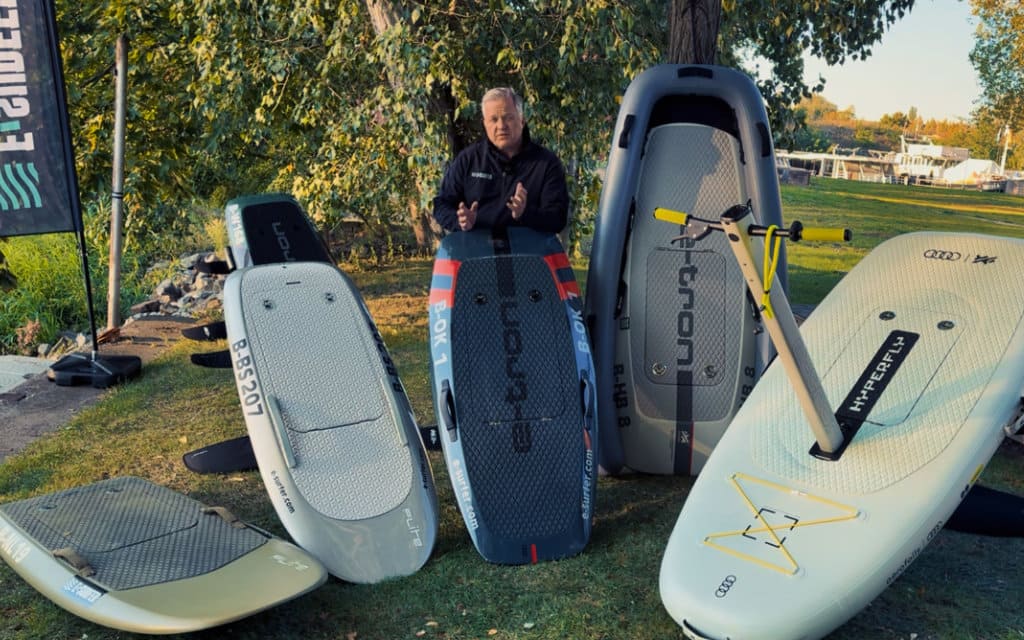
Anyone who wants to fulfill their dream of flying over water will inevitably end up researching the three market leaders in the industry and asking themselves the question: “Lift, Aerofoils, or Fliteboard?”
There is already an article with an accompanying video, “Fliteboard or Lift Foils,” which compares the eFoils from Lift and Fliteboard. Due to their origins (both companies are based directly on the ocean), both eFoil manufacturers are aimed more at fairly athletic riders. However, Fliteboard and Aerofoils also address the large target group of recreational riders, right down to eFoil scooters, which anyone can ride immediately without training.
If you want to decide between Lift Foils, Fliteboard, and Aerofoils, we recommend reading both articles. But now back to the topic at hand:
Aerofoils or Fliteboard
Both manufacturers offer absolute premium quality, but their philosophies could hardly be more different. While the Australian Fliteboard dominates the market as a pioneer with efficiency and a surfing feel, the German challenger Aerofoils (known for the Audi e-tron foil) focuses on safety and jet propulsion.
Fliteboard: The Australian market leader
Fliteboard comes from Byron Bay, Australia – one of the surfing capitals of the world. This is also evident in the product. For years, Fliteboard has been considered the “iPhone of e-foils”: extremely stylish design, a huge community, and a focus on maximum efficiency. Their goal has always been to recreate the surfing experience as purely as possible – only electrically.
Aerofoils (Audi e-tron foil): German engineering
Aerofoils is a spin-off of Audi AG and is therefore allowed to use the “Audi e-tron foil” brand. This is where aviation technology meets automotive standards. The Audi e-tron foil was developed with a clear focus: to build an e-foil that not only performs well, but is also the safest on the market thanks to its jet propulsion. It is the “car” among boards – stable, technically perfected, and safe.
For our E-SURFER YouTube channel, we have also summarized the contents of this article in a video:
Aerofoils or Fliteboard: Propeller vs. Jet
This is the most important difference when deciding between Aerofoils or Fliteboard. The riding experience and safety depend almost entirely on this component.
Fliteboard: The propeller drive
Traditionally, Fliteboard has relied on an open propeller. Although Fliteboard has been heavily promoting the Jet2 since 2025 (after the Jet1 experienced many failures in 2024), its DNA is still closely linked to the propeller. An estimated 90% of all Fliteboards sold worldwide have a propeller.
- Advantages: A propeller is physically more efficient than a jet. This means you get more “punch” at the start and often a slightly longer battery life with the same battery size. The board responds very directly to the throttle.
- Disadvantages: An open propeller poses a risk of injury in the event of a fall, which is why many Fliteboard users use a “prop guard” (protective ring), which in turn reduces efficiency.
Aerofoils: The hyperjet drive
The Audi e-tron foil uses a fully integrated jet drive (impeller) that prevents contact with fingers or toes. The Audi team is 100% focused on the jet solution and therefore does not consume any additional resources for propeller development and gearboxes. This focus is reflected in the efficiency of the system.
- Advantages: Safety. You cannot accidentally grab or kick a rotating propeller in the water. This makes the board the first choice for families, yachts, or beginners. In addition, the jet eliminates the torque that causes propellers to tilt the board slightly to the side when accelerating. You ride as if on rails.
- Disadvantages: A jet requires slightly more energy to generate the same thrust.
Conclusion: Aerofoils or Fliteboard propulsion: Do you want aggressive, direct responsiveness? Fliteboard. Are safety (e.g., because of children) and smooth running important to you? Aerofoils.
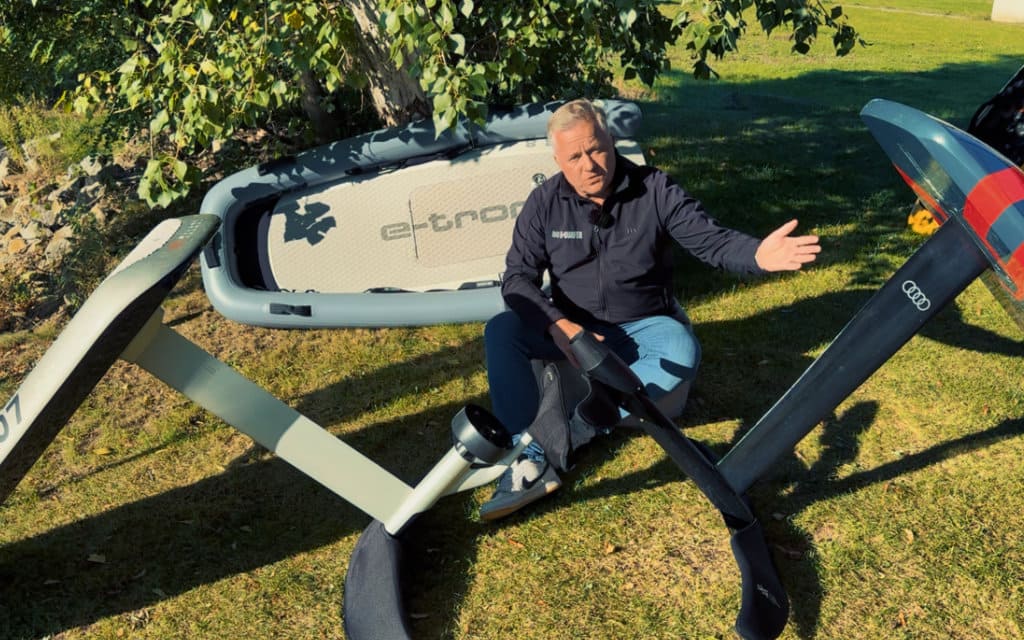
Safety and technology
This is where Aerofoils' German engineering really shines.
- Rotating parts: Aerofoils have no exposed rotating parts. Period. The psychological feeling of safety often allows beginners to learn faster, as there is no fear of the propeller.
- Remote control & connectivity: Both manufacturers offer high-end controllers.
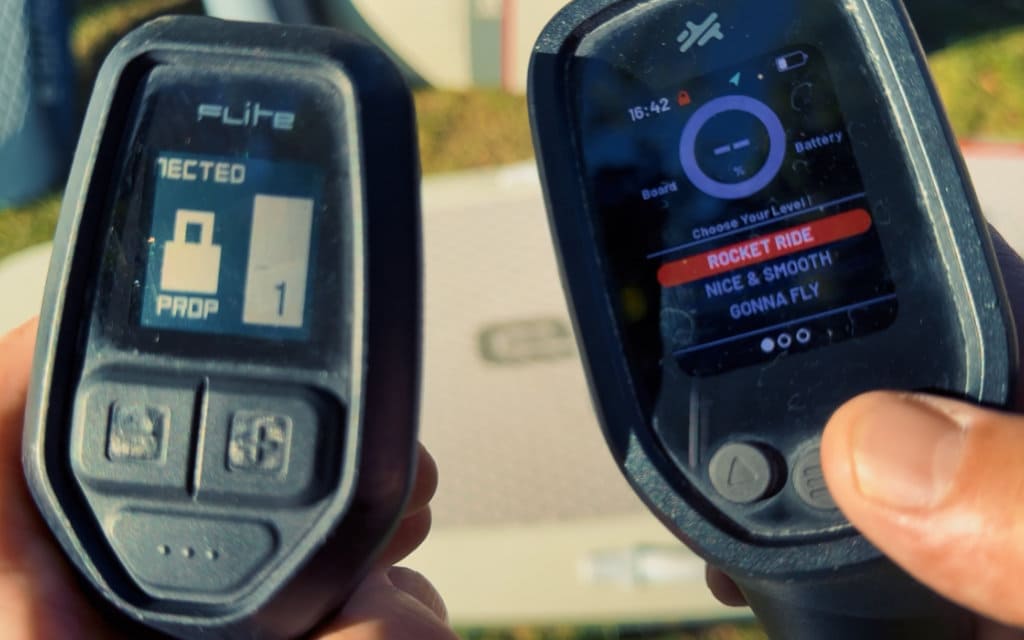
- The Fliteboard remote is known for its precise throttle response and “virtual gears” that allow you to throttle the power. However, the small black-and-white display is disappointing.
- The Aerofoils remote impresses with a very clear color display and an ergonomic shape that fits comfortably in the hand. Not only does it have 20 gears, but you can also adjust the aggressiveness of the throttle.
- Innovations: Aerofoils shines here with several unique selling points in the eFoil scene:
- Reverse gear: Only a few eFoiler use an eFoil leash. However, when dealing with strong winds or currents, it can sometimes be difficult to catch the eFoil again. That's why the Audi e-tron foil has a reverse gear to bring the board back to you.
- Battery discharge: The batteries should only be charged to a maximum of 20% for longer transport. And when storing for the winter or during longer periods of non-use, the charge should not exceed 20 to 50%. Only Aerofoils offers a function that automatically discharges the battery at the touch of a button without having to go out on the water.
Conclusion: Aerofoils or Fliteboard Innovation: Fliteboard was known for its innovations in its early years. However, after the takeover by Brunswick Corp., it has slackened off and left it to other players such as Aerofoils to shine with innovations.
Design & features
The eye rides along. Both boards are absolute status symbols.
- Fliteboard offers a huge selection of colors, materials (fiberglass, carbon, inflatable) and finishes. The workmanship is flawless, but the countless models often lead to delivery problems. The propeller models use a gearbox that produces a clearly audible whistling sound.
- Aerofoils focuses on the elegant Audi look. Lots of carbon, clean lines, and integrated technology reminiscent of modern vehicle construction. A real eye-catcher.
- Standard vs. extra charge: While the Audi e-tron foils come standard with color display remote controls, an 80 cm carbon mast, and batteries of sufficient size, these features cost extra with Fliteboard. More on this in the video.
Aerofoils or Fliteboard: Customer Support
The devil is in the details. Anyone spending over €15,000 on water sports equipment expects not only a perfect product, but also first-class service. However, according to current user experiences, this is precisely where significant differences arise.
Fliteboard Customer Support
As an Australian company, Fliteboard has a global dealer network, but reports from the community (especially in 2024/2025) paint a mixed picture.
- Challenges: Many users report a support experience that sometimes feels impersonal. There is criticism about long waiting times for replacement parts and responses that seem highly standardized – as if you were communicating with AI bots or an outsourced call center instead of real technicians.
- Warranty claims: When everything is running smoothly, Fliteboard is great. But when technical problems arise, the process can be tedious (especially without a local dealer). The focus seems to be heavily on growth and sales, with after-sales service sometimes not growing fast enough to keep up.
- Mandatory service: Fliteboard is the only eFoil manufacturer that requires servicing. (Every 100 hours or at least once a year. The drive and remote control must be sent in for this. Otherwise, you risk losing your warranty.
Aerofoils support:
At least in Europe, Aerofoils is making full use of its “home advantage” here. As a German company, Aerofoils offers a very direct line to the manufacturer. Users often praise the accessibility and competence of the contact persons.
Spare parts are usually available quickly from the German warehouse, and communication takes place on an equal footing – often directly with people who helped develop the board themselves.
Service is offered as an option, but is not mandatory.
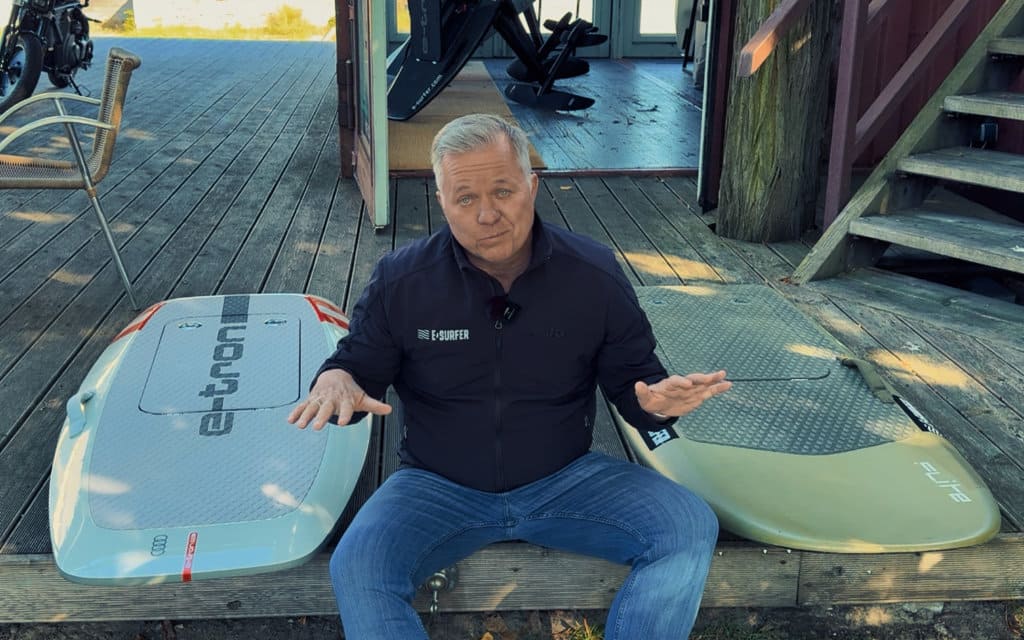
Aerofoils or Fliteboard: Pricing strategy
Fliteboard's pricing strategy: “Starting” prices vs. reality. A glance at the Fliteboard website can be misleading at first. The marketing strategy often focuses on attractive “entry-level prices” (especially for the Flite Air models), which at first glance appear to be cheaper than the competition. But be careful at checkout:
- Hidden costs: High shipping fees (sometimes around €500) are often added at the very end.
- Upgrades are mandatory: The low base price often only includes the very small battery (realistically only 30 minutes of riding time) and the slow charger. Those who, like most people, want the large battery (“Explore”) and the fast charger will quickly pay several thousand euros extra.
- Transparency: In comparison, Aerofoils' pricing often appears more transparent, as package prices are usually communicated that already include the popular, high-quality components.
Tip – Aerofoils or Fliteboard: Don't be blinded by the first price you see in the shop. Configure both boards with comparable equipment (large battery, carbon mast, fast charger, color remote control, etc.) to get a fair price comparison.
Digression: The psychology of pricing in the Fliteboard configurator
One point that many first-time buyers underestimate on the Fliteboard website is the discrepancy between the advertised “starting” price and the actual shopping cart value. The strategy is similar to that of premium car manufacturers: the base model looks attractive (e.g., the Flite Air for under $10,000), but in practice, it is not sufficiently equipped for many users. The “hidden” cost factor often lies in two essential components that are missing from the standard setup or are only included in the base version:
The charger: The base price often only includes the “slow charger.” This takes up to 9 hours to charge the large battery—completely impractical for a day at the lake. The almost indispensable “fast charger” (charging time approx. 1.5 hours) costs an additional $1,000.
The battery: The cheapest prices are often based on the smallest battery (“Nano” or ‘Sport’). If you want the maximum range (“Explore” battery), you'll also have to dig deep into your pockets.
My expert tip: When comparing prices, always configure the Fliteboard completely up to checkout (including Fast Charger & Explore Battery) before comparing it with the often more transparent total price of Aerofoils. The price difference then often melts away to zero.
eFoil Scooter - Aerofoils or Fliteboard?
Both Fliteboard and Aerofoils offer an eFoil Scooter. The HyperFly from Aerofoils and the Flitescooter from Fliteboard are huge eFoils with handlebars. With a volume of 230 liters, you can stand on the eFoil scooters without moving and hold on to the handlebars.
This allows anyone to master foiling without any water sports experience or training. We have a separate article and video on the topic of “Flitescooter or HyperFly”:
Conclusion: Aerofoils or Fliteboard?
Ultimately, the decision between Aerofoils or Fliteboard is not a question of “better” or “worse,” but a question of application.
Choose Aerofoils (Audi e-tron foil) if:
- Safety is your number one priority: You want to let your children, friends, or partners use the board without worrying about the propeller.
- You love stability: You are looking for a board that flies smoothly even in rough water and can be controlled easily.
- You are a tech aesthetic: You like the clean, technical design and the association with German automotive quality. But design is, of course, a matter of taste 😉
Choose the Fliteboard if:
- You are looking for the ultimate surfing experience: You want tight turns, agility, and a light board under your feet.
- Efficiency and range matter: You want to get the most out of a battery charge (the propeller has a physical advantage here).
No matter which model you choose, the feeling of gliding silently over the water is incomparable with both manufacturers.
FAQ: Frequently asked questions about Aerofoils or Fliteboard
Is the Audi e-tron foil faster than the Fliteboard?
In practice, both boards reach speeds of over 50 km/h, which is extremely fast on the water. The Fliteboard usually accelerates a little more aggressively thanks to its propeller, while the Aerofoils develops its power more linearly.
Aerofoils or Fliteboard: How long does the battery last?
Both manufacturers specify running times of up to 2 hours (with moderate riding). Realistically, both boards offer around 60 to 90 minutes of pure riding time, depending on the rider's weight and wind conditions.
Can beginners learn directly on these boards?
Yes.
Both manufacturers offer larger board volumes (e.g., Fliteboard Air or Aerofoils Adventure) that make it easier to get started. The Aerofoils is often considered slightly more accessible for absolute beginners due to the stability of the jet.
In addition, Aerofoils offers the Aeroloop, a great tool for the first few hours. This gives you the opportunity to start with a more sporty model such as the Performance.


 23 min read



