



Buying a used jet board sounds like a good deal. Often it isn't: private sales come without a warranty, the battery has an unknown history, and some brands no longer supply spare parts. We have been riding jetboards since 2017, and this is what you are getting into.
By Andreas Lakeberg — E-SURFER founder, eFoil expert since 2017 and board member of the Global Foil Board Sports Association (GFA)
As of October 2026
A used jet board is usually a worse deal than the price suggests. Private sales almost never include a warranty, a short test ride tells you little about the battery, and some brands no longer exist. A new board from a dealer in the EU comes with 24 months of statutory warranty, a proper introduction and service.
Buying a used jet board: where are the risks?
The risks sit in five places, and you won't see most of them on the day you pick the board up. A jetboard is technology that works in water all the time. What the previous owner did with it decides how long it will last.
- The battery: the most expensive part, with an unknown history.
- Spare parts: does the brand still exist, and does it supply parts for your model year?
- Hidden damage: water ingress, worn seals, hairline cracks in the hull.
- No warranty: in a private sale, every defect is your problem.
- Nobody to call: no one shows you how the board works, no one helps when something goes wrong.
According to E-SURFER, the real problem with a used board rarely shows on day one. It shows at the first repair, when you find out what a replacement battery costs and whether parts are still available at all.
Why is the battery the biggest risk?
Because it accounts for 30 to 40 percent of the price of a new board, and you can hardly check its condition when you buy. A tired battery eats up the saving straight away.
How healthy a lithium battery is after a few years depends on how it was treated. Was it stored empty for months in a cold garage? Was it charged with a third-party charger? Has salt water reached the connectors? None of that is in the listing, and the seller often doesn't know exactly either.
Then there is safety. A jetboard battery packs a lot of energy into a small space. With damaged or badly stored batteries, a fire is a real risk, not a theoretical one. A battery that has taken on water does not belong in a board any more.
In our tests, a ten-minute test ride is not enough to judge a used battery. Weaknesses often only show after a longer ride under load, when power suddenly drops or the board cuts out.

Does the manufacturer still exist?
This is the most important question when buying used, even before the price. If the manufacturer is gone, the board stays on land as soon as the first wear part fails. Seals, impeller, remote and battery all need replacing on a jetboard sooner or later.
And exactly these boards are often offered second-hand. The jetboard market is young, and quite a few manufacturers have given up in recent years. To our knowledge they include Lampuga, Radinn, Onean, Waveshark and YuJet, and the list is certainly not complete. Before any used purchase, check whether the manufacturer still supplies parts and who can service the board near you.
The best-known example is the Lampuga Air. Lampuga has ceased operations, and batteries and kill switches are completely sold out. A used Lampuga without a working battery can no longer be made rideable. What accessories are still available is listed in our article Lampuga ceases operations.
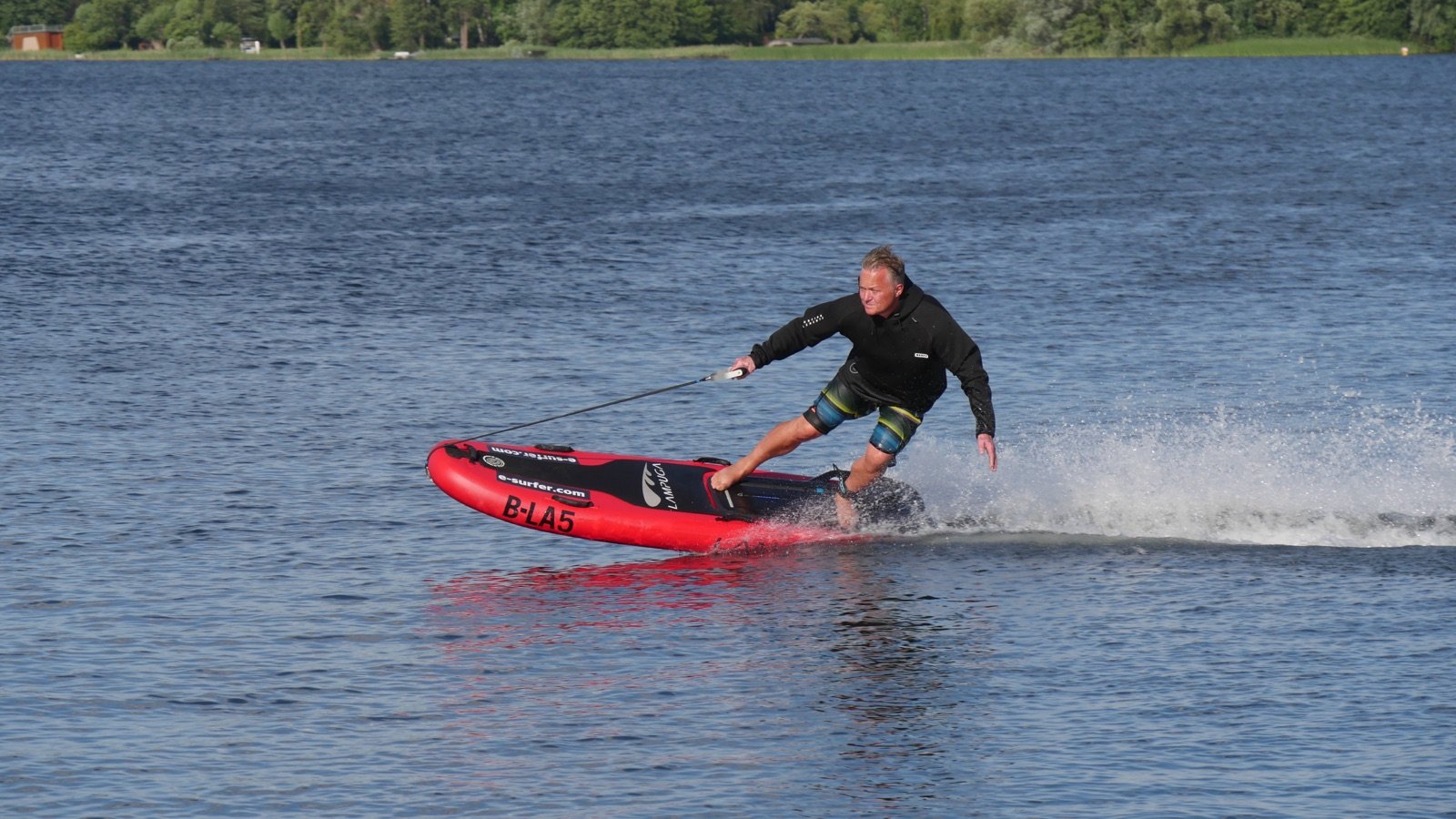
For the brands we carry, we keep spare parts in stock: mo-jet, Awake Boards and JETSURF. In a private sale you have no claim to any of that. You have to find the parts and organise the repair yourself.
Which damage can't you see when buying used?
Mainly water ingress, wear on the drive and fine cracks in the hull. All three are easy to miss when you look at a board on the shore.
- Water ingress: if the seals on the battery compartment are worn, water reaches the electronics. Salt marks in the compartment or green deposits on the connectors are a warning sign.
- Impeller and intake: a jetboard has an impeller in a duct instead of an open propeller. That is safe, but sensitive to sand and gravel. Nicked blades show the board was often used in shallow water.
- Hull: a carbon hull is light and stiff but takes hard knocks less well. A hairline crack can let water in. Plastic hulls such as the mo-jet are much more robust.
- Petrol engine: on models with a combustion engine, the operating hours say more than the model year. A two-stroke that has been standing for a long time often needs workshop time first.
What rights do you have in a private sale?
Usually none. Private sellers can exclude any warranty, and almost every listing says “sold as seen, no warranty, no returns”. If the battery fails three weeks later, the repair is on you.
If you buy new from a dealer in the EU, you get 24 months of statutory warranty. Then there is the question of ownership: always ask for the original invoice when buying used. Without it you can't be sure the board actually belongs to the seller.
What comes after buying a used jet board?
Registration, transport and an introduction you have to organise yourself. In the UK there is no national licence for a jetboard. Registration depends on where you ride: on inland waterways the navigation authority, for example the Environment Agency on the Thames or the Canal & River Trust, requires registration and third-party insurance, and some councils such as Anglesey have their own rules. If you buy used, check whether the board is registered and transfer the registration to your name. Details are in our article eFoil rules in the UK.
Transport isn't trivial either. Because of its battery, an electric jetboard ships as dangerous goods, so a private seller can't simply post it. In practice that means you drive there and pick it up yourself.
Why doesn't E-SURFER sell used jetboards?
Because we can't stand behind a used board the way we stand behind a new one. As a dealer we would have to give a warranty on used boards too. For a battery whose history we don't know, we can't do that responsibly.
That is why the E-SURFER shop only sells new boards that we have ridden ourselves and for which we keep spare parts. It is the better basis for you: you know where the board comes from, and you have someone to call if something happens.
Used or new: which is the better choice?
For almost everyone, the new board. The price gap shrinks quickly once you factor in a replacement battery, a repair or the missing warranty.
New jetboards cost between €12,000 and €20,000 in 2026. In our shop they start at €12,388 for the Awake RÄVIK Explore. The mo-jet SURF starts at €14,995 and the JETSURF Electric 2 at €14,869. For that you get 24 months of warranty, an introduction and spare parts from the dealer.
E-SURFER expert Andreas Lakeberg explains: “A used jetboard is a board with a history you don't know. If you are looking for a board for the family, the holiday home or the yacht, a new, robust board serves you better and often costs less in the end.”
You'll find all models with prices under buy a jet board. Not sure it should be a jetboard at all? Our guide Jetboard or eFoil? explains the difference. And before you decide: ride the boards yourself on a test ride in Berlin.
What should you check if you buy used anyway?
At least these six points, on site and on the water:
- Original invoice for board and battery, with date
- Battery compartment and connectors: water, salt marks, corrosion
- Impeller and intake: nicks and foreign objects
- Hull: cracks, especially on carbon
- Complete accessories: remote, kill switch leash, original charger
- Test ride of at least 15 minutes under load
You can ask questions about a specific model in the E-SURFER forum, where riders who have owned their boards for a while share their experience.
Frequently asked questions about used jetboards
Is a used jetboard worth it?
Rarely. The battery accounts for 30 to 40 percent of the new price, and you can hardly check its condition when you buy. Private sales also usually come without a warranty. A new board from an EU dealer comes with 24 months of statutory warranty.
What warranty do I get when buying a used jetboard privately?
Usually none. Private sellers can exclude the warranty, and almost all of them do with “sold as seen”. If the battery fails three weeks later, you pay for it yourself.
Should I buy a used jetboard if the manufacturer no longer exists?
No, at most as a project. Without a manufacturer there are no replacement batteries and no parts. To our knowledge this applies to Lampuga, Radinn, Onean, Waveshark and YuJet, among others. For Lampuga, batteries and kill switches are completely sold out.
Do I have to re-register a used jetboard?
Usually yes, if it is registered. In many countries registration is tied to the owner, so the change of ownership has to be reported. The details depend on the country.
Does E-SURFER sell used jetboards?
No. As a dealer we would have to give a warranty on used boards too, and we can't do that responsibly for a battery with an unknown history. We only sell new boards that we have ridden ourselves.


 9 min read


