How long does an eFoil battery really last? Ride time, charging time, range and lifespan – based on our experience from lessons and test rides and the specs of six manufacturers.
By Andreas Lakeberg — founder of E-SURFER, eFoil expert since 2017 and board member of the Global Foil Board Sports Association (GFA)
Updated: November 2026
An eFoil battery lasts about 45 to 90 minutes in real-world riding. For a large battery with a fast charger, our rule of thumb is “ride for 1.5 hours, charge for 1.5 hours”. Manufacturers quote 45 to 150 minutes, but the top figures only apply under ideal conditions: a light rider, flat water and a steady speed.
How long can you ride on one charge?
With a large battery you get around 90 minutes of real-world riding, with a small battery about 45 minutes. These are not lab figures but our experience from test rides, lessons and customer feedback. We have been testing all leading eFoil models ourselves since 2017.
For their large batteries, most manufacturers quote 90 to 135 minutes, and Fliteboard even up to 2.5 hours for its biggest battery. These are “up to” figures. As E-SURFER founder Andreas Lakeberg puts it: “Two hours works for a 40-kilo (90 lb) rider with a tailwind on a straight line. If you ride normally, carve turns and restart now and then, plan for an hour and a half.” SiFly shows how specific these figures are: its 120 minutes apply to a 75 kg (165 lb) rider at a relaxed 15 km/h (9 mph).
Very small batteries such as Fliteboard’s Flitecell Nano are an exception. The manufacturer quotes up to 45 minutes; in practice it is closer to 25 minutes. That is by design: it is light and agile for wave riding, not for long tours.
How far can you go on an eFoil?
On one charge you can cover about 20 to 40 km (12 to 25 miles), depending on the battery and your speed. Aerofoils quotes 20 km for its small Light battery and 40 km for the large Endurance battery, and Fliteboard “over 40 km” as a maximum. The other manufacturers only give a ride time, not a range.
Range depends more on speed than ride time does: if you glide at a relaxed pace, you go further than someone riding at top speed all the time. How fast an eFoil actually goes is covered in our article How fast is an eFoil?.
Which eFoil battery sizes do manufacturers offer?
Most manufacturers offer two or three battery sizes so you can choose between a lighter board and a longer ride, for example Aerofoils with “Light” and “Endurance”. The large batteries have 2,100 to 2,550 watt-hours, the small ones 500 to 1,130. The table shows the manufacturers’ specs for current models, without any ranking.
| Battery | Wh | Ride time max. | Fast charge |
|---|---|---|---|
| Aerofoils Light | 1,130 | 60 min | 1 h 15 min |
| Aerofoils Endurance | 2,230 | 120 min | 2 h |
| Lift Foils LIFTX Battery | 1,000 | 45 min | 80 % in 30 min |
| Lift Foils Gen5 Full Range (LIFT5) | 2,200 | 90 min | 80 % in approx. 1 h |
| Awake Boards Flex Battery LR 4 | n/a | 60 min | n/a |
| Awake Boards Flex Battery XR 4 | 2,550 | 120 min | n/a |
| Fliteboard Flitecell Nano | 806 | 45 min | under 50 min |
| Fliteboard Flitecell Sport | 1,600 | 90 min | under 1.5 h |
| Fliteboard Flitecell Explore | 2,100 | 150 min | under 2 h |
| Waydoo Powerflight (Flyer EVO) | 1,800 / 2,300 | 100–135 min | n/a |
| SiFly PowerCell LR | approx. 2,330* | 120 min | under 3 h |
Manufacturer specs as of November 2026. n/a = not stated by the manufacturer. * SiFly states 52 V and 44.8 Ah; the watt-hours are calculated from that. Ride times are maximum figures; Waydoo quotes different values on different pages of its website.
Keep in mind when comparing: manufacturers measure differently, and not every figure states rider weight or speed. Capacity in watt-hours is therefore a better guide than the number of minutes.
What reduces ride time?
Frequent starts, a heavy rider and a constantly high speed use the most power. Manufacturers confirm this: according to Fliteboard, full throttle with lots of restarts can push ride time below one hour. Other factors:
- Skill level: Beginners fall more often, restart and spend longer in the water before taking off. Lift Foils explicitly points out that new riders get less ride time.
- Rider weight: The heavier the rider and gear, the more power the board needs to take off and glide.
- Wing size: A large wing lifts early and glides efficiently at low speed. A small wing needs more speed and therefore more power.
- Wind, waves and current: Headwind and choppy water noticeably cut ride time.
- Cold: A cold battery delivers less energy, says Aerofoils. That is why ride time is often shorter in spring and autumn than in summer.
According to E-SURFER, riding style is the biggest lever: if you get up on the foil early and glide smoothly, you get far more ride time out of the same battery than someone who keeps going full throttle and restarting.
How long does charging take?
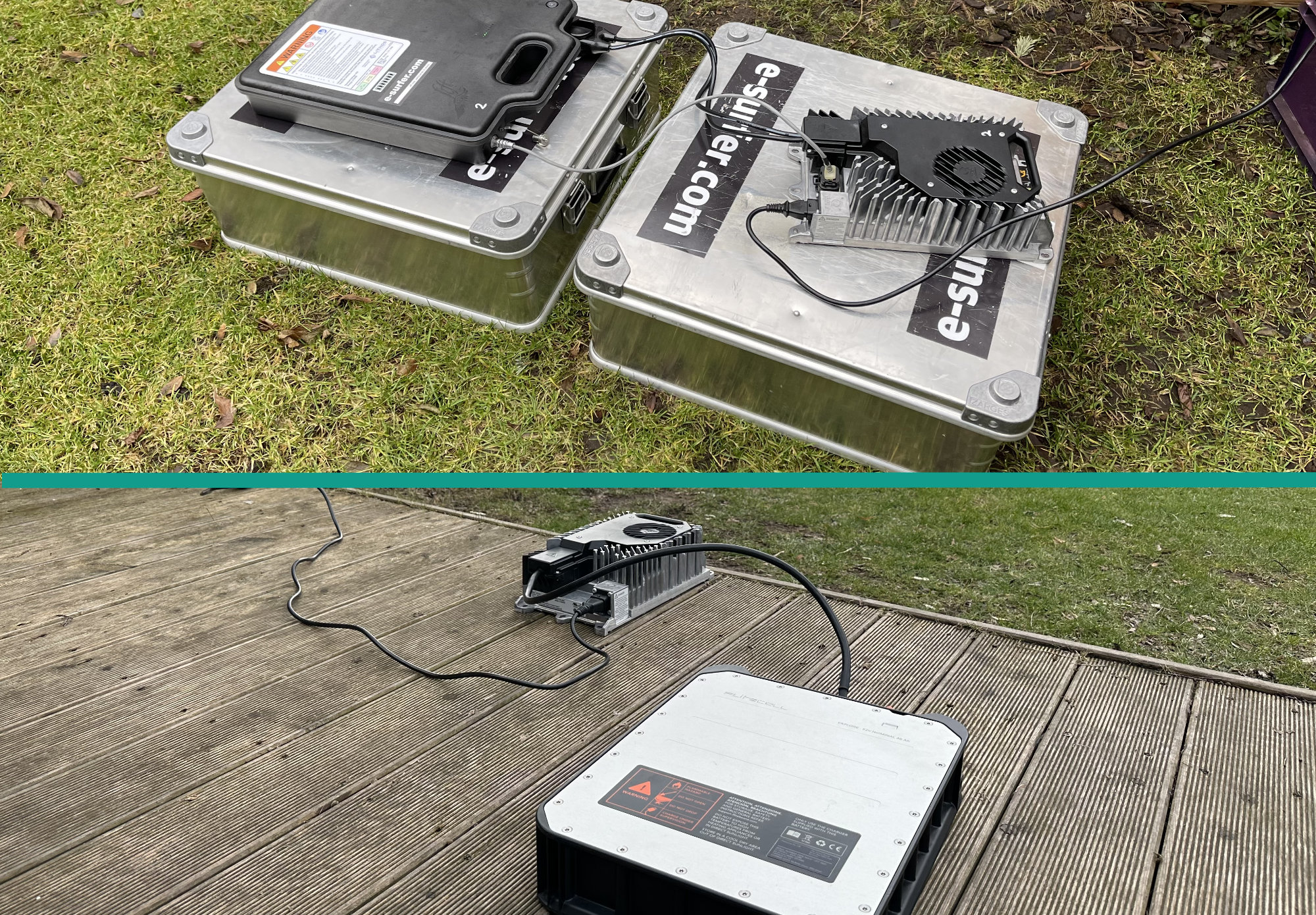
A large battery is full in about 1.5 to 2 hours with a fast charger, a small one in 50 minutes to 1 hour 15. With the slower standard charger it takes much longer: at Aerofoils 3 hours 15 for the small and 5 hours 30 for the large battery, at Fliteboard up to 9 hours for the biggest one.
Almost all manufacturers offer two chargers: a standard charger that comes with the board and a more powerful fast or premium charger. If you often ride twice a day, buy the fast charger right away. The difference is especially big at Fliteboard: the standard charger is so small that a battery takes many hours to charge.
For a long day on the water, that means: ride, take a break, charge, ride again. If you want to keep riding without a break, you need a second battery. Waydoo advises letting the battery cool down after riding before you charge it.
How many years does an eFoil battery last?
An eFoil battery lasts many years if you look after it. Our experience at E-SURFER: we only sell premium eFoils, and the oldest batteries of our customers are now five years old and still work perfectly.
Manufacturers give a one- to two-year warranty on their batteries. Waydoo and SiFly also limit the warranty to 300 charge cycles. None of the six manufacturers states how much capacity a battery retains after a given number of cycles.
How do you look after the battery?
Store the battery half charged, cool and dry. For longer breaks, manufacturers recommend a charge level between 30 and 60 percent, and Aerofoils adds 18 to 23 °C (64 to 73 °F). Don’t leave the battery in direct sun, only charge it with the original charger and rinse the connectors with fresh water after riding in salt water.
We explain this in detail in Safe storage of lithium-ion batteries and, for the winter break, in How to store your eFoil in winter.
Can you take an eFoil battery on a plane?
No. On passenger flights, lithium-ion batteries are only allowed up to 100 watt-hours, or up to 160 watt-hours with the airline’s approval. That is the rule of the US FAA, the airline association IATA and the EU agency EASA. Even the smallest eFoil battery, at 500 watt-hours, has more than three times that, and Aerofoils’ Endurance battery has 2,230.
The manufacturers also state clearly that their batteries are not allowed on passenger aircraft. As dangerous goods (Class 9, UN 3480), large batteries can only be shipped on cargo aircraft and at no more than 30 percent charge. That is why most people who want to ride on vacation rent an eFoil locally. You can find schools and rentals on the map at efoil-spot.com.
Is a second or larger battery worth it?
A second battery is worth it if you want to ride for more than 1.5 hours a day or share the board with several people. A larger battery pays off for long tours. A small battery saves weight, at Fliteboard for example 6.2 instead of 14.5 kg (14 instead of 32 lb), and makes the board more playful.
Batteries are among the most expensive parts of an eFoil; you can read why in Why are eFoils so expensive?. Which battery sizes are available for each model is shown with the boards in our eFoil shop. How motor, battery and controls work together is explained in How does an eFoil work?.
Frequently asked questions about the eFoil battery
How long does an eFoil battery last on one charge?
In real-world riding about 45 to 90 minutes, depending on battery size, rider weight and riding style. Manufacturers quote up to 150 minutes, but only under ideal conditions.
How long does it take to charge an eFoil battery?
About 1 to 2 hours with a fast charger and 3 to 9 hours with the standard charger, depending on battery size and brand.
How far can you go on an eFoil?
About 20 to 40 km (12 to 25 miles) per charge, depending on the battery and your speed.
Can I take an eFoil battery on a plane?
No. Passengers may carry batteries of no more than 160 Wh, while eFoil batteries have 500 to 2,550 Wh. They can only be shipped as dangerous goods on cargo aircraft.
How many years does an eFoil battery last?
Many years if you look after it. The oldest batteries of our customers are five years old and still work perfectly. Manufacturers give a one- to two-year warranty.


 29 min read