


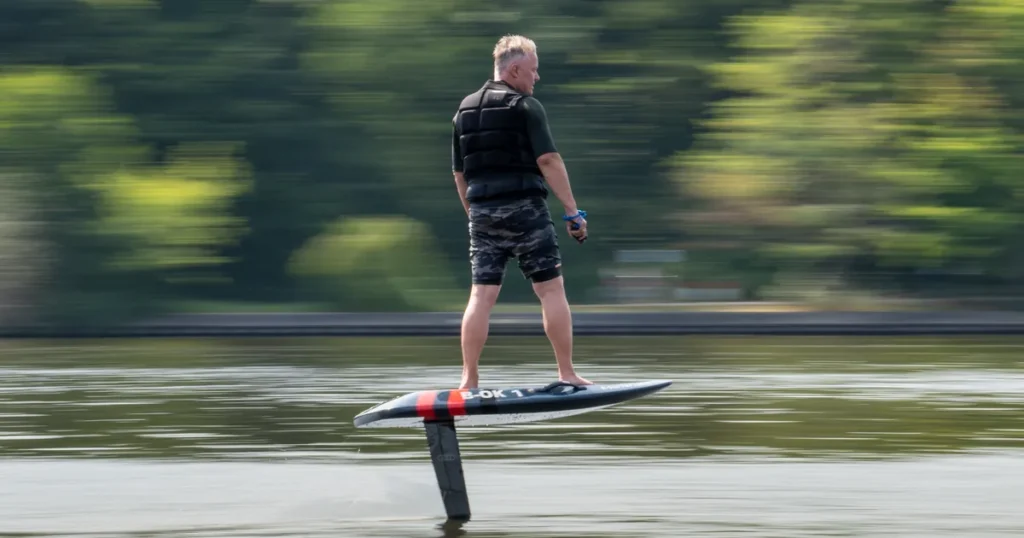
Can you ride an eFoil in the USA? Yes – but in the US, your board counts as a boat. We pulled together the rules of the US Coast Guard and all 50 states from official sources: registration, boater education, PWC status and the pitfalls in Hawaii, California and Florida.
By Andreas Lakeberg — E-SURFER founder, eFoil expert since 2017 and board member of the Global Foil Board Sports Association (GFA)
As of October 2026
Yes, eFoils in the USA are legal – but legally they are boats. The US Coast Guard classifies eFoils as “vessels.” That means you need to register your board in practically every state, carry a life jacket and, depending on the state, hold a boater education card. There is no federal operator license and no federal minimum age.
eFoils in the USA: what applies at the federal level?
At the federal level, the answer is clear: the US Coast Guard explicitly classifies eFoils as “vessels” – with all the obligations of a motorized recreational boat.
The basis is the Coast Guard's vessel determinations, which list eFoils and jetboards alongside kiteboards and paddleboards. Policy Letter 22-02 (October 5, 2022) calls the eFoil a “Mechanically Propelled Personal Hydrofoil” and states that it is subject to all laws and regulations for recreational vessels propelled by machinery. The Coast Guard itself lists what that means on the water:
- Registration with your state (Certificate of Number) – carry the card while riding.
- Life jacket: one approved PFD per person; children under 13 must wear it (33 CFR 175).
- Sound-producing device, such as a whistle.
- Navigation lights if you ride at night or in restricted visibility.
- Engine cut-off switch: use it if your board comes with one.
- Fire extinguisher: not required if everyone is wearing a PFD.
There is no federal boating license or minimum age – both are left to the 50 states. That is exactly why the rules for eFoils in the USA vary so much from state to state. For this article, we analyzed the Coast Guard's requirements and those of every state using only official agency and legal sources.
Do you have to register an eFoil in the USA?
Yes, eFoils in the USA must be registered in practically every state, because registration applies to every motorized vessel – regardless of length or type of propulsion.
Four states mention eFoils explicitly. In California, the DMV says “motorized eFoils and jet boards” are subject to titling and registration. Hawaii requires registration “regardless of the power output of the motor,” with the number displayed on the board. North Dakota explicitly lists eFoils among the vessels that must be registered. In New Jersey, according to the minutes of the Boat Regulation Commission from July 2023, the Motor Vehicle Commission registers eFoils with a hull identification number (HIN) and a certificate of origin.
Other states state explicitly that electric motors count too – including New York, Virginia, Pennsylvania, Wisconsin, Wyoming, West Virginia, Delaware, Alaska and New Mexico. All other states refer to “motorized” or “mechanically propelled” vessels, and an eFoil falls under that.
We found two possible exceptions: Washington exempts vessels under 16 feet with 10 hp or less – but only on non-federal waters, so not on Puget Sound, for example. Michigan exempts “surfboards” from registration; whether that includes motorized boards is not clear from the wording. We would register in both states anyway. If you rent an eFoil locally, registration is the rental company's job as the owner – but depending on the state, you still need your own boater education card.
Do you need a boating license for an eFoil in the USA?
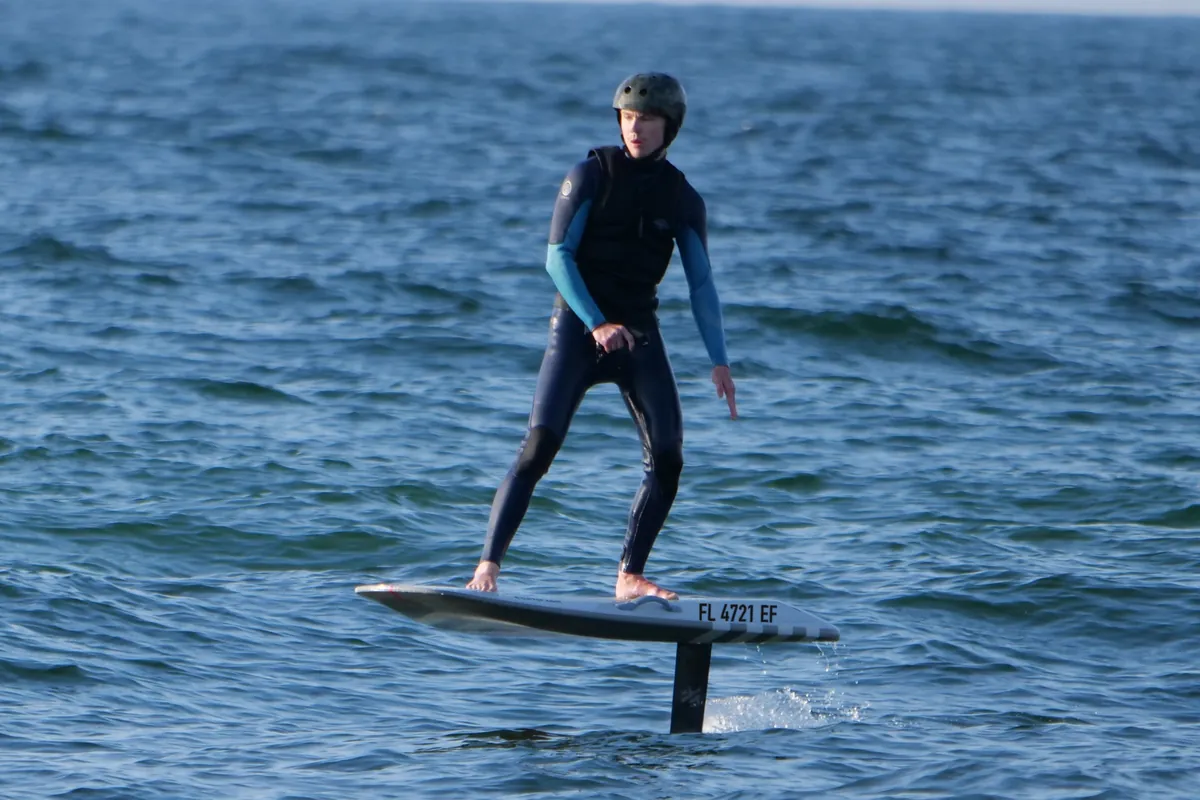
Whether you need a boating license for eFoils in the USA depends on the state, your year of birth and sometimes the motor's power rating. The proof is called a “boater education card” – a safety course with an exam that the state recognizes.
Based on our analysis, the states fall into four groups:
- Required for every operator: California and New York (both since 2025), New Jersey, Connecticut, Alabama and Washington, D.C. Massachusetts is phasing the requirement in through 2028.
- Required by year of birth – the largest group: for example Florida (born 1988 or later), Texas (born on or after September 1, 1993), Georgia (born 1998 or later) or Maryland (born on or after July 1, 1972).
- Required for young operators only: for example Colorado (ages 14 to 17), Kentucky (12 to 17) and Oklahoma (12 to 15).
- Not required: Alaska, Idaho and Wyoming.
Many states also tie the requirement to a horsepower threshold, such as 10 hp in Florida, North Carolina, Virginia and Hawaii or 15 hp in Texas and Washington. Whether your eFoil is above it depends on the rated power of its motor. Hawaii is the only state that converts the threshold explicitly: 10 hp equals about 7.457 kW.
According to E-SURFER, the most important rule for eFoil riders in the USA is: register your board with the responsible state before your first ride and carry the card. As for the boating license: when in doubt, get the boater education card – apart from Hawaii, no state says how it converts horsepower thresholds for electric motors.
E-SURFER expert Andreas Lakeberg, October 2026
Is an eFoil considered a jet ski in the USA?
For eFoils in the USA, there is no uniform answer: some states treat them like jet skis (personal watercraft, PWC), others explicitly do not.
Utah lists E-Foils in its official FAQ as an example of personal watercraft – next to Jet Skis and Sea-Doos. Hawaii, on the other hand, states clearly: “E-foils and Foil Drive boards are not PWCs.” Pennsylvania reached the same conclusion in 2023 because its PWC definition requires an internal combustion engine; the responsible board recommended changing it. The Coast Guard explicitly leaves it to the states to number eFoils as “Personal Watercraft” or as “Other.”
Why this matters: in many states, PWCs face stricter rules – such as a ban on riding at night, a minimum age of usually 14 to 16, a requirement to wear the life jacket or bans on small lakes. Where the definition requires a water jet pump, a propeller-driven eFoil usually does not qualify. Based on our review of the statutes, an eFoil is a PWC by wording in 13 states, not in 17 states, and unclear in 9.
Do different rules apply to jetboards in the USA?
Often, yes: a gas-powered jetboard meets the PWC definition by wording in all 39 states whose definition we could access – with all the stricter rules. For electric jetboards, the picture is mixed.
Here too, the basis is Policy Letter 22-02: the Coast Guard calls jetboards a “Mechanically Propelled Surfboard,” explicitly with electric or internal combustion propulsion, and also classifies them as “vessels.” What matters next is each state's PWC definition. Almost all require water jet propulsion and an operator who stands, sits or kneels – which fits every jetboard. Some also require an internal combustion engine.
- Gas-powered jetboard (for example JETSURF): a PWC by wording in all 39 states we could evaluate.
- Electric jetboard (for example Awake Ravik or mo-jet): a PWC in 17 states, not in 5 (Connecticut, Delaware, Kentucky, New Jersey, Pennsylvania), unclear in 17 because those states only refer to an “inboard motor.”
- New York names motorized surfboards with water jet propulsion explicitly: they are subject to the same rules as personal watercraft.
The difference is especially important in national parks. The National Park Service defines PWCs by an internal combustion engine powering a water jet pump (36 CFR 1.4) and allows them only in 21 parks with special regulations (36 CFR 3.9). A gas-powered jetboard falls under this; electric boards do not by wording. However, the National Park Service has not addressed eFoils or electric jetboards explicitly – check with the park in advance. How jetboards and eFoils differ on the water is explained in Jetboard or eFoil; you will find all models in our jetboard comparison.
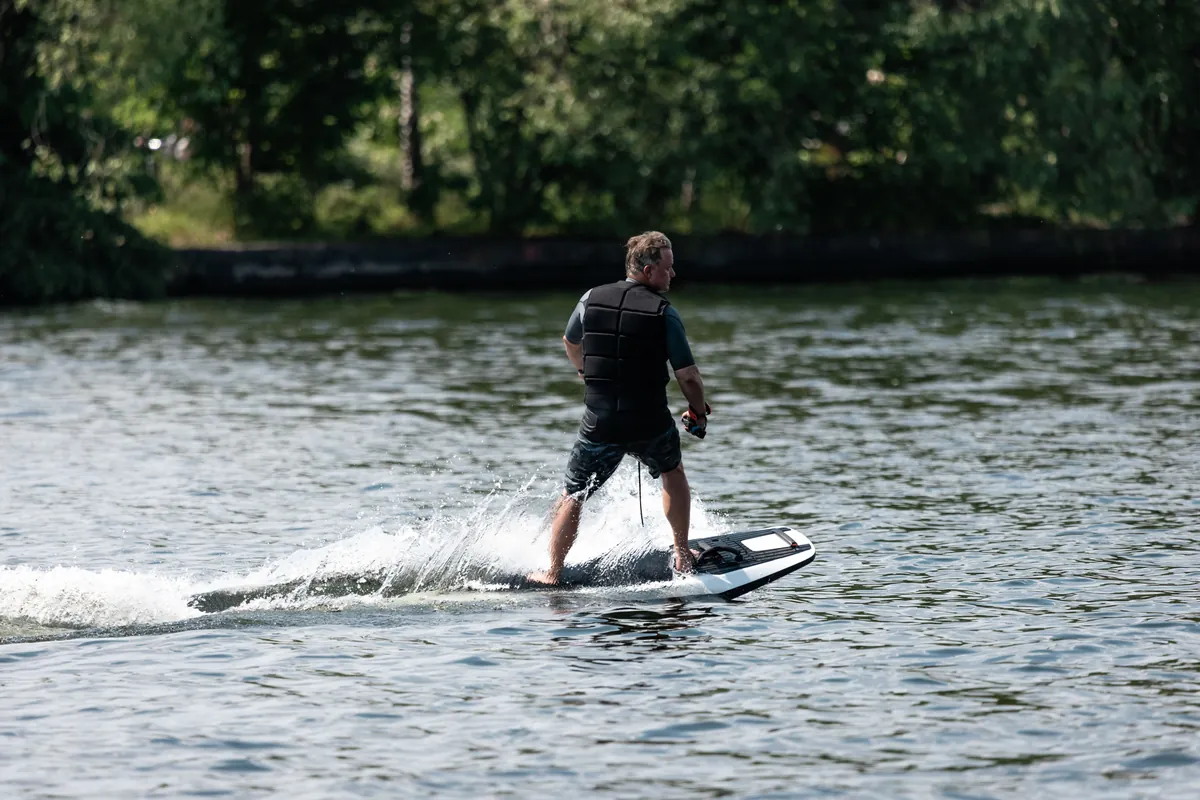
Where can you ride an eFoil in the USA? Hawaii, California, Florida and Lake Tahoe
The rules for eFoils in the USA are best documented in Hawaii and California. Florida applies its general boating rules plus manatee protection zones, and Lake Tahoe requires an inspection. To see where other eFoilers already ride, check the worldwide eFoil Spot map.
Hawaii
Hawaii is the only state with a dedicated eFoil page from its boating agency DOBOR. eFoils and Foil Drive boards are motorboats there – Foil Drive boards even when you also pump. They must always be registered and, beyond the surf zone, need lights, a sound-producing device and an engine cut-off switch. Within 200 feet of the shore, surfers and swimmers, slow-no-wake speed applies, usually 5 mph at most (HAR 13-244). On top of that, there are zones where motorized vessels are prohibited (HAR 13-256).
California
California requires registration with the DMV and, since 2025, the California Boater Card for every operator of a motorized vessel, regardless of age. Watch out in the Monterey Bay National Marine Sanctuary: its definition of motorized personal watercraft is so broad that eFoils are included – they may only operate in four designated zones (15 CFR 922, Subpart M).
Florida
In Florida, every motorized vessel must be registered (F.S. 328.48), and anyone born in 1988 or later needs the course for motors of 10 hp or more. Florida defines PWCs by water jet propulsion – a propeller-driven eFoil does not qualify by wording. Also watch for manatee protection zones with speed limits for motorboats. We did not find a statement on eFoils from the Florida Fish and Wildlife Conservation Commission (FWC); its website is not accessible from Europe.
Lake Tahoe
At Lake Tahoe, between California and Nevada, eFoils are explicitly listed as “hand-launched electric watercraft” by the Tahoe Regional Planning Agency's inspection program. You need an annual inspection and a valid sticker before launching.
Pitfalls: Connecticut and Vermont
In Connecticut, a regulation prohibits “self-propelled water-skis or surf boards” (Sec. 15-121-A10). It covers, among others, boards steered only by shifting your weight – which, by wording, includes eFoils. There is no interpretation from the state's environmental agency DEEP; ask them before your first ride. In Vermont, motorized vessels may not be operated so that the hull completely leaves the water – which is exactly what happens when foiling. Whether the authorities apply this to eFoils is open as well.
eFoils in the USA: all states at a glance
The table summarizes the rules for eFoils in the USA state by state; each state name links to the official source. “Born … or later” means the requirement applies to everyone born on or after January 1 of that year. For Nevada, New Hampshire and Oregon, we could not access an official source because their agency websites are blocked from Europe. In most states, the requirement follows from the general rule for motorized vessels, not from an eFoil-specific regulation. All information without guarantee – only the responsible agency is authoritative.
| State | Boater education | Registration | Note |
|---|---|---|---|
| Alabama | all operators of motorized vessels (vessel license) | required | — |
| Alaska | not required | required, incl. electric motors | — |
| Arizona | no requirement found | required | — |
| Arkansas | born 1986 or later | required | — |
| California | everyone (California Boater Card, since 2025) | required, eFoils named explicitly | eFoil named |
| Colorado | ages 14–17 only | required | — |
| Connecticut | everyone (boating certificate) | required | Caution |
| Delaware | born 1978 or later | required, incl. electric motors | — |
| Washington, D.C. | everyone (boating safety certificate) | required | — |
| Florida | born 1988 or later, 10 hp and up | required | Manatee zones |
| Georgia | born 1998 or later | required | — |
| Hawaii | 10 hp (≈ 7.5 kW) and up | required regardless of power output | eFoil named |
| Idaho | not required | required | — |
| Illinois | born 1998 or later, over 10 hp | required | — |
| Indiana | unclear | required | — |
| Iowa | ages 12–17 only, over 10 hp | required | — |
| Kansas | born 1989 or later (up to age 20) | required | — |
| Kentucky | ages 12–17 only, over 10 hp | required | — |
| Louisiana | born 1984 or later, over 10 hp | required | — |
| Maine | born 1999 or later, over 25 hp | required | — |
| Maryland | born on or after July 1, 1972 | required | — |
| Massachusetts | phased in for everyone by 2028 | required | — |
| Michigan | born on or after July 1, 1996, over 6 hp | required (“surfboards” exemption unclear) | — |
| Minnesota | operator permit, phased in by 2028 | required | — |
| Mississippi | born on or after July 1, 1980 | required | — |
| Missouri | born 1984–2005 on lakes; from 2027 born 2006 or later | required | — |
| Montana | ages 13–14 only, over 10 hp | required | — |
| Nebraska | born 1986 or later | required | — |
| Nevada | no official source accessible | no official source accessible | — |
| New Hampshire | no official source accessible | no official source accessible | — |
| New Jersey | everyone (boating safety certificate) | required, eFoils are being registered | eFoil named |
| New Mexico | born 1989 or later | required, incl. electric motors | — |
| New York | everyone (since 2025) | required, incl. electric motors | — |
| North Carolina | born 1988 or later, 10 hp and up | required | — |
| North Dakota | ages 12–15 only, over 10 hp | required, eFoils named explicitly | eFoil named |
| Ohio | born 1982 or later, over 10 hp | required | — |
| Oklahoma | ages 12–15 only, over 10 hp | required | — |
| Oregon | no official source accessible | no official source accessible | — |
| Pennsylvania | born 1982 or later, over 25 hp | required, incl. electric motors | eFoil named |
| Rhode Island | unclear | probably required | — |
| South Carolina | born on or after July 2, 2007, 10 hp and up | required | — |
| South Dakota | no requirement found | required | — |
| Tennessee | residents born 1989 or later, over 8.5 hp | probably required | — |
| Texas | born on or after Sept. 1, 1993, over 15 hp | required | — |
| Utah | ages 12–17 only (PWC) | required | eFoil = PWC |
| Vermont | born 1974 or later | required | Caution |
| Virginia | everyone, 10 hp and up | required, incl. electric motors | — |
| Washington | everyone, 15 hp and up | required (exemption up to 10 hp only on non-federal waters) | — |
| West Virginia | born on or after Dec. 31, 1986 | required | — |
| Wisconsin | born 1989 or later | required | — |
| Wyoming | not required | required, incl. electric motors | — |
eFoils in the USA vs. Europe: what is different?
The biggest difference: in the USA, an eFoil is a boat that must be registered everywhere, while in Europe each country decides for itself – from France's own vehicle category to a de facto ban in Switzerland.
There is an interesting parallel to Germany: there, you need a license from 7.5 kW – almost exactly the threshold Hawaii sets with 10 hp. In Germany, however, a registration plate is required from just 2.21 kW. You will find all the details in our guide to eFoil rules in Europe, country by country and in our article on eFoils in the UK. Our community map shows where other riders go.
We have tested all leading eFoil models ourselves since 2017. Which board suits you – eFoil, jetboard or another surfboard with a motor – is shown in our comparison.
Legal notice: This article is for general information only and does not constitute legal advice. We have carefully compiled all information from official US agency sources (as of October 2026) but make no warranty as to its accuracy, completeness or timeliness. Laws and regulations change, and local rules may differ. Only the regulations and statements of the responsible authorities are binding – please check the current rules locally before every ride. Any liability for damages arising from the use of this information is excluded to the extent permitted by law.
Frequently asked questions about eFoils in the USA
Do you need a license to ride an eFoil in the USA?
For eFoils in the USA, it depends on the state. California, New York and New Jersey require a boater education card from every operator, most states only from a certain birth year, and Alaska, Idaho and Wyoming require none.
Do you have to register an eFoil in the USA?
Yes, in practically every state, because registration applies to every motorized vessel. Hawaii explicitly requires it regardless of motor power, and California names eFoils in its registration rules.
Is an eFoil considered a jet ski (PWC) in the USA?
Not uniformly. Utah explicitly counts eFoils as personal watercraft, while Hawaii explicitly says they are not. This matters because PWCs often face night-riding bans and higher minimum ages.
Can you ride an eFoil in Hawaii?
Yes. In Hawaii, eFoils are motorboats, must be registered with DOBOR, and slow-no-wake speed applies within 200 feet of the shore, surfers and swimmers. Some zones ban motorized vessels entirely.
Can you ride an eFoil in US national parks?
The national parks' PWC rules refer to an internal combustion engine powering a water jet pump, so electric eFoils do not fall under that wording. The National Park Service has not addressed eFoils explicitly, so check with the park before you go.
Do these rules apply to every eFoil brand?
Yes. US rules do not depend on the brand. Whether you ride a Fliteboard, a Lift Foils board or an Aerofoils eFoil (formerly Audi e-tron foil), the board is treated like any other motorized vessel. What matters is the state you ride in, whether it requires a registration number and whether you need a boater education card.


 18 min read



